Navigating The First 90-180 Days In A New CISO Role

Late one Friday afternoon a call comes in and you find out you landed your next CISO role. All the interview prep, research, networking and public speaking has paid off! Then it dawns on you that you could be walking into a very difficult situation over the next few months. Even though the interview answered a lot of questions, you won’t know the reality of the situation until you start. How will your expectations differ from reality? What can you do to minimize risk as you come up to speed? How should you navigate these first 90-180 days in your new role?

Prior To Starting

Let’s assume you have some time to wind down your current position and you are also going to take some time off before starting the new role. During this transition period I highly advise you reach out to your peers in the new role and start asking questions to get more detail about the top challenges and risks you need to address. Start with the rest of the C-Suite, but also get time with board members and other senior business leaders to get their perspectives. Focus on building rapport, but also gather information to build on what you learned during the interview process so you can hit the ground running.

You can also use this time to reach out to your CISO peers in your network who are in the same industry, vertical or company type to get their perspective on what they did when they first joined their company. Learn from their experience and try to accelerate your journey once you start. Keep the lines of communication open so if you run into a situation you are unsure of you can ask for advice.

Once You Start

Build Relationships

First and foremost, start building relationships as quickly as possible. Target senior leadership first, such as board members, the C-Suite and other senior leaders. Work your way down by identifying key influencers and decision makers throughout the org. Play the “new person card” and ask questions about anything and everything. Gain an understanding of the “operational tempo” of the business such as when key meetings take place (like board meetings). Understand the historical reasons why certain challenges exist. Understand the political reasons why challenges persist. Understand the OKRs, KPIs and other business objectives carried by your peers. Learn the near and long term strategy for the business. Start building out a picture of what the true situation is and how you want to begin prioritizing.

Understand the historical reasons why certain challenges exist. Understand the political reasons why challenges persist.

Plan For The Worst

Don’t be surprised if you take a new role and are immediately thrown into an incident or other significant situation. You may not have had time to review playbooks or processes, but you can still fall back on your prior experience to guide the team through this event and learn from it. Most importantly, you can use this experience to identify key talent and let them lead, while you observe and take notes. You can also use your observation of the incident to take notes on things that need to be improved such as interaction with non-security groups, when to inform the board, how to communicate with customers or how to improve coordination among your team.

Act With Urgency

Your first few months in the role are extremely vulnerable periods for both you and the company. During this period you won’t have a full picture of the risks to the business and you may not have fully developed your long term plan. Despite these challenges, you still need to act with urgency to gain an understanding of the business and the risk landscape as quickly as possible. Build on the existing program (if any) to document your assumptions, discoveries, controls and risks so you can begin to litigation proof your org. Map the maturity of security controls to an industry framework to help inform your view of the current state of risk at the company. Begin building out templates for communicating your findings, asks, etc. to both the board and your peers. Most importantly, the company will benefit from your fresh perspective so be candid about your findings and initial recommendations.

Evaluate The Security Org

In addition to the recommendations above, one of the first things I like to do is evaluate the org I have inherited. I try to talk to everyone and answer a few questions:

  1. Is the current org structure best positioned to support the rest of the business?
  2. How does the rest of the business perceive the security org?
  3. Where do we have talent gaps in the org?
  4. What improvements do we need to make to culture, diversity, processes, etc. to optimize the existing talent of the org?

Answering these questions may require you to work with your HR business partner to build out new role definitions and career paths for your org. You may also need to start a diversity campaign or a culture improvement campaign within the security org. Most importantly, evaluate the people in your org to see if you have the right people in the right places with the right skillsets.

A Plan Takes Shape

As you glide past the 90 day mark and start establishing your position as a trusted business partner, you should arrive at a point where a clear vision and strategy is starting to take shape. Use the information you have gathered from your peers, your program documentation and your observations to start building a comprehensive plan and strategy. I’ve documented this process in detail here. In addition to building your program plan you can also begin to more accurately communicate the state of your security program to senior leaders and the board. Show how much the existing program addresses business risk and where additional investment is needed. I’ve documented a suggested process here. Somewhere between your 90 and 180 day mark you should have a formalized plan for where you are over invested, under invested or need to make changes to optimize existing investment. This could include restructuring your org, buying a new technology, adjusting contractual terms or purchasing short term cyber insurance. It could even include outsourcing key functions of the security org for the short term, until you can get the rest of your program up to a certain standard. Most importantly, document how you arrived at key decisions and priorities.

Take Care Of Yourself

Lastly, on a personal note, make sure to take care of yourself. Starting a new role is hectic and exciting, but it is also a time where you can quickly overwork yourself. Remember building and leading a successful security program is a marathon not a sprint. The work is never done. Get your program to a comfortable position as quickly as possible by addressing key gaps so you can avoid burning yourself out. Try to establish a routine to allow for physical and mental health and communicate your goals to your business partners so they can support you.

During this time (or the first year) you may also want to minimize external commitments like dinners, conferences and speaking engagements. When you start a new role everyone will want your time and attention, but be cautious and protective of your time. While it is nice to get a free meal, these dinners can often take up a lot of time for little value on your end (you are the product after all). Most companies have an active marketing department that will ask you to engage with customers and the industry. Build a good relationship with your marketing peers to interweave customer commitments with industry events so you are appropriately balancing your time and attending the events that will be most impactful for the company, your network and your career.

Wrapping Up

Landing your next CISO role is exciting and definitely worth celebrating. However, the first 90-180 days are critical to gain an understanding of the business, key stakeholders and how you want to start prioritizing activities. Most importantly, build relationships, act with urgency and document everything so you can minimize the window of exposure as you are coming up to speed in your new role.

How Should CISOs Think About Risk?

There are a lot of different ways for CISOs to think about and measure risk, which can be bucketed into two different categories. Qualitative measurement, which is a subjective measurement that follows an objective process or quantitative measurement, which is an objective measurement grounded in dollar amounts. Quantitative risk measurement is what CISOs should strive to achieve for a few reasons. One, it grounds the risk measurement in objective numbers which removes people’s opinions from the calculation; two, it assesses risk in terms of dollar amounts, which is useful for communicating to the rest of the business; and three, it can highlight areas of immaturity across the business if they are unable to quantify how their division contributes to the overall bottom line of the company. In this post I want to explore how CISOs should think about quantitatively measuring risk and in particular, measuring mitigated, unmitigated and residual risk for the business.

Where should you start?

A good place to start is with an industry standard risk management framework like NIST 800-37, CIS RAM or ISO 31000 and for the purposes of this post I’ll stick with the NIST 800-37 to be consistent. In order for CISOs to obtain a qualitative risk assessment from the NIST 800-37 they need to add a step into the categorize step by working with finance and the business owners to understand the P&L of the system(s) they are categorizing. The first step is to go through every business system and get a dollar amount (in terms of revenue) for how much the systems(s) contribute to the overall bottom line of the business.

Internal and External Security Costs

After you get a revenue dollar amount for every set of systems, you now need to move to the assess stage of the NIST 800-37 RMF to determine which security controls are in place to protect the systems, how much they cost and ultimately what percentage the security controls cover. There are two categories of security controls and costs you will need to build a model for. The first category is internal costs, which includes:

  • Tooling and technology
  • Licenses
  • Training
  • Headcount (fully burdened cost)
  • Travel
  • R&D
  • Technology operating costs (like cloud costs directly attributable to security tooling, etc.)

The second category is external costs, which includes:

  • 3rd party penetration tests
  • Audits
  • Managed Security Service Provider (MSSP) costs
  • Insurance

As you fill in the costs or annual budget for each of these items you can map the coverage of these internal and external costs to your business to determine the total cost of your security program and how much risk the program is able to cover (in terms of a percentage).

Mapping Risk Coverage

Once you have all of these figures you can start to map risk coverage to determine if your security program is effectively protecting the business. Let’s say your business generates $1B in annual revenue. Your goal as a CISO is to maintain a security program that provides $1B of risk coverage of the business. Or, if you are unable to provide total coverage, then you need to communicate which parts of the business are not protected so the rest of the C-Suite and board can either accept the risk or approve additional funding.

As a simple example, let’s say you spend $1M/year on a SIEM tool, which takes 6 people to operate and maintain. The total cost of the 6 people is approximately $6M / yr (including benefits, etc.). The SIEM and people provide 100% monitoring coverage for the business and the SIEM and people can be mapped to 20% of your security controls in NIST. I’m skipping a lot of details for simplicity, but for a $1B business this means your SIEM function costs $7M / yr, but protects $200M of revenue ($1B x 20%). As you map the other tools, processes, people, etc. back to the business you will get a complete picture of how much risk your security program is managing and make informed decisions about your program to the board.

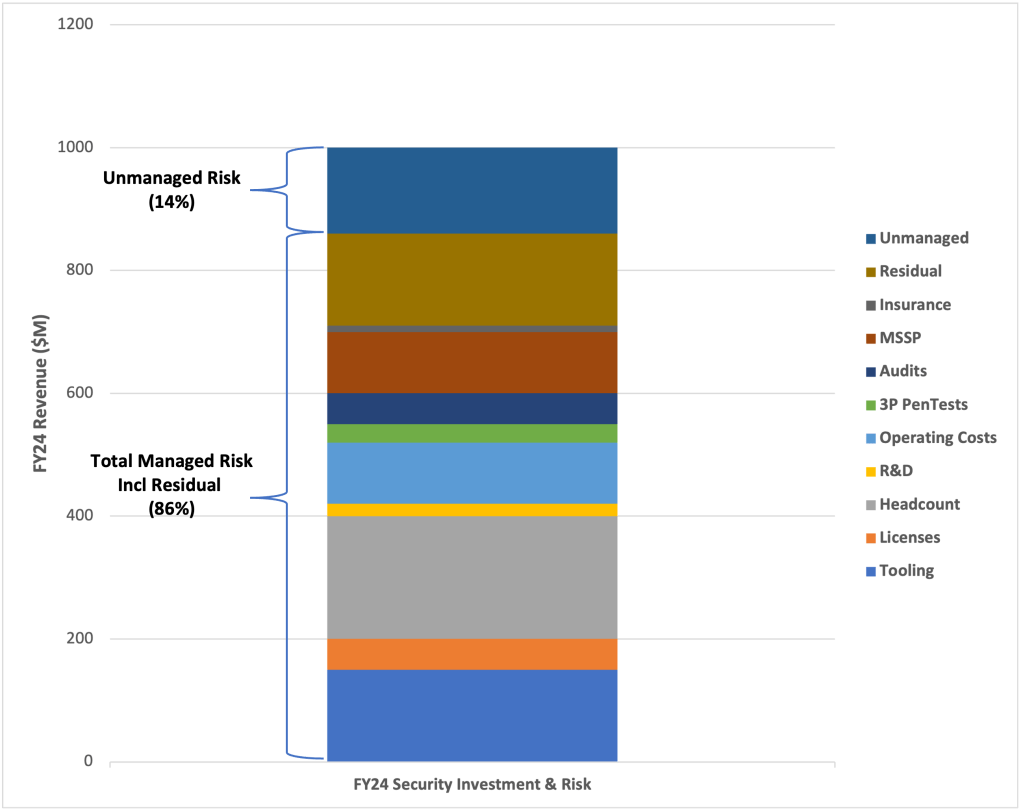
For example, you may find your security program costs $100M / year, but is only able to manage risk for $750M (75%) of the business. Your analysis should clearly articulate whether this remaining 20% of risk is residual (will never go away and is acceptable) or is unmanaged and needs attention.

Complete The Picture

By mapping your security program costs to the percentage of controls they cover and then mapping those controls to the business, CISOs should be able to get an accurate picture of the effectiveness of their security program. By breaking out the security program costs into the internal and external categories I’ve listed above, they can also compare and contrast the costs to the total amount of risk to determine which investments yield the best value. These analyses can be extremely effective when having conversations with the rest of the C-Suite or board, who may be inclined to decline additional budget requests or subjectively recommend a solution. By informing these stakeholders of the cost per control and the risk value of that cost, you can help them support your recommendation for additional investment to help increase risk management coverage or to help increase the value of risk management provided by the security program.

The following chart is an example of what this analysis can yield.

Once you have this data and analysis you can start driving conversations with the rest of the C-Suite and the board to inform them of how much risk is being managed, how much is residual, how much risk is unmanaged and your recommendation for additional investment (or acceptance). These conversations can also benefit from further analysis such as the ratio of cost to managed risk to determine which investment is providing the best value and ultimately support your recommendation for how the company should manage this risk going forward (people or technology).

Wrapping Up

Managing P&L is a fundamental skill for all CISOs to master and can help drive conversations across the company for how risk is being managed. CISOs need to master skills in financial analysis and partner with other parts of the business like business operations or business owners to understand how the business operates and what percentage of the business is effectively covered by the existing security program. The results of this analysis will help CISOs shape the conversation around risk, investment and ultimately the strategic direction of the business.

Should CISOs Be Technical?

Don’t want to read this? Watch a video short of the topic here.

There are a lot of different paths to becoming a CISO and everyone’s journey is different, however two of the most common paths are coming up through the technical ranks or transitioning over from the compliance function. Coming up through the technical ranks is common because cybersecurity is a technically heavy field, particularly when attempting to understand the complexities of how exploits work and the best way to defend against attackers. Coming up through the compliance ranks is also common because companies are often focused on getting a particular compliance certification in order for them to conduct business and interact with the customers. Each of these paths offers advantages and disadvantages, but I will argue being technical is more challenging than some of the softer cybersecurity disciplines like compliance, which leads to a common question – do CISOs need to be technical?

Yes, but…

If you don’t want to read any further the short answer is yes, CISOs need to be technical. The longer answer is, being technical is a necessary, but insufficient characteristic of a well rounded CISO. The reason being technical is insufficient is because for the past few years the CISO role at public companies has been transforming from a technical role to a business savvy executive role. CISOs are expected to report to the board, which requires speaking the language of business, risk and finance. I have seen CISOs quickly lose their audience in board meetings when they start talking about tooling, vulnerabilities and detailed technical aspects of their security program. CISOs need to be able to translate their security program into the language of risk and they need to be savvy enough to weave in financial and business terminology that the board and other C-Suite executives will understand.

Obtain (and maintain) A Technical Grounding

Even though being technical is no longer sufficient for a well rounded CISO it is important for a CISO to obtain or maintain a technical grounding. A technical grounding will help the CISO translate technical concepts (like vulnerabilities and exploits) into higher level business language like strategy, risk or profit and loss (P&L). It is also important for a CISO to understand technical concepts so they can dig in when needed to make sure their program is on track or controls are operating effectively. Lastly, it is important to maintain technical credibility with other technical C-Suite stakeholders like the CTO and CIO. Speaking their language will help align these powerful C-Suite members with your security program, who can then lend critical support when making asks for the rest of the C-Suite or board.

What other skills does a CISO need?

In addition to a technical grounding, there are a number of skills CISOs need to master in order to be effective in their role. The following is a short list of skills CISOs need to have in order to be successful at a public company:

  • Executive presence and public speaking skills with the ability to translate security concepts into business risk that resonates with senior executives and the board
  • Ability to lead and communicate during a crisis
  • Politically savvy, with ability to partner with and build alliances with other parts of the business
  • Ability to understand the core parts of the business, how they operate and what their strategy is
  • Ability to explain the “value” of your security program in business and financial terms
  • Strong understanding of financial concepts such as CAPEX, OPEX, P&L, budgeting and ability to understand balance sheets, earning results and SEC filings
  • Understand and navigate legal concepts (such as privilege), regulations and compliance activities with the ability to map these concepts back to your security program or testify in court (if needed)
  • Ability to interact with auditors (when needed) to satisfy compliance asks or guide responses
  • Ability to interact with customers to either reassure them about the maturity of your security program or act as an extension of the sales team to help acquire new customers
  • Interact with law enforcement and other government agencies, depending on the nature of the business

If this seems like a long list that doesn’t fit your concept of what a CISO does, then you may have some weaknesses you need to work on. This list also reflects the evolving nature of the CISO role, particularly with respect to board interaction and leadership at public companies. More importantly, a lot of these concepts are not covered in popular security certifications and you definitely won’t get all of this experience from start ups or non-public companies. That is ok, because recognizing and acknowledging your weaknesses is the first step to becoming a better CISO.

The Dichotomy Of Security

If you have ever read Extreme Ownership or The Dichotomy of Leadership by Jocko Willink, then you will be familiar with the concept of dichotomy and how opposing forces of a skill set can compliment each other. Mastering both sides can allow flexibility and increase the effectiveness of that skill set when dynamically applied to a given situation. This is true in the security space, where fundamental opposing forces need to be balanced in order to manage risk and achieve success. Let’s take a look at a few examples.

Security Extremes

The easiest example of the dichotomy of security is to look at the extremes. Security professionals jokingly say the most secure company is one that is not connected to the internet. While this may be true, it will also prevent the company from conducting business effectively and so the company will cease to exist and security will no longer be needed.

On the other end of the spectrum there is the extreme of a business that has zero security and so there are no impediments to conducting business. While this may sound great to some, the reality is the company will be unable to effectively conduct business because of the real threats that exist on the internet. In the situation the company will also cease to exist because they will be hacked into oblivion.

It is obvious there is a dichotomy between no security and no connectivity and these forces need to be appropriately balanced for a security program to be effective, while allowing the business to operate.

Manual vs Automated Security

Another example of dichotomy is between manual security tasks and automation. While every CISO I know is striving to increase automation of security tasks, the reality is humans are still going to be needed in any security program for the foreseeable future.

Manual tasks are ideal for situations where humans need to demonstrate creativity, intuition or make complex decisions based on subtle context. Security functions like penetration testing, threat hunting, red teaming and offensive security require high amounts of skill and experience that automation, like AI, hasn’t been able to replicate. Additionally, soft skills such as reporting to the board, shifting culture, building alliances and making prioritization decisions are all extremely complex and unlikely candidates for automation. However, while manual activities benefit activities that require a high degree of creativity, they are inherently slow and can impede the normal flow of business.

Recently, the advances in automation and artificial intelligence have exponentially increased their usefulness. Automation is extremely useful for offloading repeatable tasks that lend themselves to being programmatically defined. For example, attack simulation products have made huge strides in offloading repetitive tasks of reconnaissance, enumeration, vulnerability assessment and remedial exploitation. We are seeing additional advances in automation related to incident response where events can be correlated and specific activities in an IR playbook can be completed to offload analysts and help focus their attention. AI has also helped to offload lower level operational activities like call centers and help desk inquiries.

While automation may accelerate parts of the business and offload humans from repeatable tasks, it does introduce complexity, which can be difficult to troubleshoot or can cause outright failures. Automation is also rigid because it is only as good as the parameters of the process it is following. This means it can’t think outside of the box or demonstrate creativity. There is also the risk of introducing bias into your processes if your underlying model is flawed.

As you can see manual security processes and automated security processes are opposing forces that need to be balanced based on the skill of your security team and the needs of the business.

The Human Problem

The last dichotomy I want to discuss is the human problem in security. Humans are necessary because of their creativity, diversity and capacity for adapting to an infinite number of situations. However, the flexibility in human nature also presents one of the fundamental security problems – how to you protect against human nature?

The reality is humans are flawed, but in a good way. Threat actors can try to take advantage of these flaws, whether they are logical (like firewall rules) or physical (like human psychology). Humans are essential to every aspect of a business and so we have to figure out how to protect them. The most difficult balance in security is developing a program that is comprehensive enough to protect against human nature without stifling it.

The Security Ideal

The ideal security program will recognize the dichotomy of the security challenges it faces and balance them accordingly. The ideal security program balances security with flexibility. We are seeing this balance manifest in mature security programs via concepts like security guard rails and the paved path. The paved path and guard rails attempt to allow a certain amount of latitude for acceptable behavior, while being rigid enough to protect users and the business accordingly.

Application In Other Domains

The concept of dichotomy is universal across any domain. In fact, this is an area of extensive research in disciplines like mathematics, computer science, military strategy, and economics. Specifically, in the space of network and graph theory there is a concept call max flow, min cut. These are counter principles that are opposite, yet complimentary. If you think of any network (road, supply chain, computer network, etc.) the point of maximum flow across that network is also the point where maximum disruption (minimum cut) can occur. From a military or security stand point you will want to protect the max flow/min cut, but from an attacker stand point, the max flow / min cut, is the area that will require the least amount of effort for maximum damage. Pretty neat!

Wrapping Up

An effective security program will balance the needs of security with the needs business with the ultimate goal of effectively managing risk. A critical skill for any security practitioner is to be flexible and adaptive. Specifically, by recognizing that security issues have two sides to them, security practitioners can demonstrate empathy towards the business and find an appropriate balance that can protect without impeding the business.

Annual Planning For CISOs

The beginning of the year is a popular time for making personal resolutions, which can focus on health, finance or love. While the beginning of the year is a popular time to set resolutions, really what we are talking about is setting goals to improve ourselves. I’m a huge proponent of setting personal goals for the year because it gives focus and purpose to your actions. The beginning of the year is also a great time to review the annual goals of your security program to set your focus and establish priorities. Annual planning has several objectives that CISOs need to consider and include in their process and I’ll cover them in the rest of this post.

Strategic Planning (Strat Planning)

Strategic, or “strat” planning as it is sometimes called, looks at where the business and your organization want to be over a long term time period. Something like 18 months to 5 years is typical in strat planning. The planning session should include discussion of the one or more of the following macro level business topics:

  • Market forces and opportunities
  • Industry trends
  • Regulatory and legal landscape
  • Competition
  • Customer sentiment, goals, etc.
  • Economic and financial environment
  • Geo-political climate
  • Technology trends and latest research

This discussion could be part of a SWOT analysis (Strengths, Weaknesses, Opportunities, Threats), but the goal is to understand where your business is and where you want it to go in the long term.

Align The Security Program

Once the business has a strategic plan, the CISO should conduct a similar planning exercise for where they want the security program to be. These are sometimes called “North Stars”, but they are essentially high level objectives over the long term that merge technology trends, regulatory requirements and security goals into long term objective. These won’t be very specific, but instead should act as guidance for where your team should focus and hopefully end up over the next few years.

Examples

An example of a strategic trend and security objective are as follows:

Trend: As companies shift from the datacenter to the cloud and bring your own device (BYOD), the concept of a traditional perimeter no longer makes sense.

Strategic Security Objective: Shift to a zero trust strategy where identity becomes the perimeter.

The goal is to choose big ticket objectives that will take multiple years to achieve, but will provide guidance to your org and the rest of the business about the direction your team is taking. Your strategic plan will inform the next section, which is your operational plan.

Operational Planning (Op Planning)

Operational planning is more tactical in nature and covers a shorter time period than strategic planning. Op planning usually follows either a fiscal or calendar year that way it aligns to performance reviews and budgeting cycles. In op planning the CISO will select the high level goals they want the security organization to complete that year. Usually op planning will include discussion and planning of the following:

  • Budget creation, forecasting and changes
  • Headcount planning
  • Technology investments (if any)
  • Top risks to focus on
  • Any audits or compliance certifications needed that year
  • Development of timing and roadmap for completing specific projects and tasks
  • Discussion of security controls and services
  • Skill gaps and training requirements

The point is to create a tactical plan for the year that will inform your team’s specific goals and objectives. These goals should be clear and measurable. I typically use an iterative approach to break my goals down to my directs and then they break their goals down to their teams and so on. This ensures alignment throughout the business.

Measuring and Adjusting

One important aspect of any plan is to continually measure progress and adjust if needed. Goals and objectives aren’t useful if the business has shifted and they are no longer relevant or have become un-obtainable.

Wrapping Up

Strategic and operational planning are important activities for every CISO. These plans define the long term vision for the security organization and break down that vision into tactical objectives that are accomplished throughout the year. This post discussed a high level overview of what goes into strategic and operational planning, but aligning security plans to business risk, mapping security controls, obtaining funding and reporting progress are all complex activities that every CISO needs to master.

Exploring The Advantages and Disadvantages of Centralized vs. Decentralized Teams

This blog post is part of the Compliance Corner Series developed in partnership with Milan Patel. This series includes a variety of discussion topics around the intersection of security and compliance. The series includes blog posts, live web streams (with Q&A) and podcasts.


What is more effective – A decentralized or centralized security and compliance team? What are the factors you need to consider, what are the pros and cons of each model, does company size matter, are they simply analogs of organizational maturity or should leaders consider one model over another model for their org?

  1. When leaders are creating or maturing their organization should they consider a centralized or decentralized organization structure?

Lee: If you have the opportunity to create or modify your organization I personally prefer a centralized organization structure. This is because it concentrates the roles, responsibilities and authority for security into a single function that can offer governance and all of the additional expertise expected of a security organization. The rest of the business knows where to go and who to talk to for all security issues. I have seen problems arise in both decentralized and heavily matrixed organizations because it confuses the roles and responsibilities of the function. Who is actually responsible for making security decisions if major parts of security are spread out across the organization? Sharing resources doesn’t really work very well because it is confusing for the individual team members and when sharing resources one side typically loses out to the other side. I have also seen shared resources get mis-used or repurposed for things other than security. This doesn’t mean the security team can’t place resources in different parts of the org, but they should report into and be owned by the security function. In my opinion whoever is responsible for the budget and the headcount truly controls that resource and decentralizing the budget and headcount causes problems.

Milan: Business leaders must first consider what role they want their compliance organizations to have. Will their compliance team actually offer governance, or just auditing? Are they going to cover corporate policies, or just audit frameworks that attest to customer reports? These are important scope questions to answer before setting up (or maturing) a compliance organization. It can drastically change how you fund and scope skills for the team, and whether a decentralized team will meet the overall risk management and corporate goals.

Investment size must also be considered, I get that question all the time, “How much should a business invest in compliance?”. I have seen everyone from flat personnel-project based funding, to actual percent of overall business operations spend. I focus on scope first, as then you can directly cost out what the deliverables/responsibilities are. Governance will drive a big factor of centralized or decentralized teams. Governance requires authority, charter, and appropriate level of independence to actually hold teams accountable. In a decentralized model, governance becomes much more difficult, as the fox ends up guarding the hen house.

  1. Does company size, organizational maturity or other factors influence the decision to have a centralized vs. decentralized organization?

Lee: Company size can definitely influence the initial decision to create a centralized or decentralized function. Smaller organizations or startups may not be able to justify the initial cost of a dedicated security leader and may lump this responsibility under the CIO, CTO or Chief Counsel. As a result the security function may initially grow as a decentralized function until the organization decides it is either time to offload the original leader or they realize they need more specific security leadership and it is time to build out a dedicated function.

Organizational maturity can also impact the decision. Immature organizations may struggle to effectively use decentralized resources and so the weaker the organizational culture the more a centralized security organization will make sense. However, in really large organizations it is common to see a hybrid approach which I like to call a federated model. In a federated model you have a centralized security organization that sets policy, governance, manages risk, makes decisions and has all the authority for anything security. Business units within the large company then staff specific security resources based on expertise for specific industries or to help navigate their specific security and regulatory requirements. This can be advantageous in terms of presenting a single view of overall risk, consolidating processes and leveraging economies of scale for purchases to get a better price for tools or contracts used for security across the organization.

Milan: Company size, and breath of products, can definitely influence the model. In smaller companies, there will likely be less resourcing (and complexity) to consider, which makes a centralized model more affordable and practical. You are not going to have much ability to fund a larger team (and wouldn’t likely need it), so a centralized model pretty much is the only option.

In larger companies, decentralization is used (and we’ll talk about advantages and disadvantages later), but the better model is hub and spoke. A strong central team, chartered with governance, but small “spoke” compliance teams that are the boots on the ground in the team. Small presence that can keep engineering on track, participate in design reviews, threat model reviews, and know enough to ensure that engineering teams and products are on the right track from the start. They also can drive best practices for that team, but they are based on the central team requirements, and can escalate to the central team (that ideally has a governance charter) to ensure adherence at the right senior level.

  1. What are the advantages and disadvantages of each model?

Lee: Centralized models offer consolidation of budget, resources, governance, responsibility and authority. It presents a single function that the rest of the business can go to for anything security related. Centralized models are typically more efficient because it avoids each group having to create and duplicate resourcing, tooling and processes. The one downside of a centralized model is if the security organization forgets that the rest of the business is their customer then it can become extremely difficult to interact with that group who effectively becomes a gatekeeper for business progress.

Decentralized models can offer some initial advantages when companies are extremely small. This is typical during startups or when you are operating in a mode where everyone is doing a lot of different jobs. However, this usually isn’t sustainable long term. I also find people who operate in this mode usually can’t scale to a larger organization where more governance is required. Decentralized models are also more prone to duplication of resources, technology and processes because there isn’t a single leader coordinating strategy and investment. Decentralized functions can also run into problems where the resources are misused or go “native” and stop performing the intended security role. Decentralized functions may end up with different levels of maturity across the different groups in the organization, which can make it difficult to obtain compliance certifications or to standardize processes and technology for a unified approach to security.

Milan: In general, a centralized structure offers the best overall coverage and governance. You can set consistent policies and practices across multiple organizations, which inherently will reduce risk as it’s easier to ensure consistency, and accuracy with one process vs many. You also can provide more controls to validate continuously that processes are working, plus attest much easier. Continuous compliance in a cloud environment is basically the norm now, but not all organizations, especially those with a decentralized model, can effectively ensure compliance of many regulations that come in and now must be enforced at the corporate level, and not just at the product level.

You also reduce cost, as having one set of compliance experts is cheaper, and can provide more optimization of skills. In a decentralized model, you end up having to hire more individuals, as you must replicate specialized skills in multiple areas. 

One aspect that is often overlooked in centralized vs decentralized is pricing power. For compliance, for instance, you can collective bargain auditing to drive better prices in a centralized model. In a decentralized model, every team is determining it’s own bidding and metrics, which basically allows for suppliers to cost every team as individuals, reducing the overall negotiating power of the company. In a decentralized model, you usually also have more junior leaders (as the team and overall scope is smaller), and that dilutes the overall governance credibility, as they are not truly objective, as again, this can give the impression of the fox guarding the hen house.

  1. Is there a clear winner here or is this more of a dogmatic approach / “it depends” type of answer?

Lee: Obviously there is always an “it depends” type of answer, but I personally think a centralized team offers far more advantages than a decentralized team. I have operated in decentralized teams, startups, and heavily matrixed organizations and they have all had incredible inefficiencies, process problems, lack of technological standardization and contention between the leaders in control of the different resources. While anyone can demonstrate leadership, the reality is there can only be one leader for a function. If you want to build a strong and effective security organization my personal recommendation is to avoid the decentralized model and strongly advocate for a consolidated, centralized function for all of the reasons I listed above. 

No matter what size your company is, at some point your business will get big enough that it will either need to transition to or will need to build a centralized security org. Even when your company gets truly massive a centralized security organization will offer tremendous advantages for coordinating the rest of the functions across the business. This doesn’t mean you can’t have specific expertise embedded within the different lines of business, but there should be one overarching function that sets strategy, governance and has the authority to coordinate everything related to security across the organization.

Milan: I am going to lead off with a “it depends”, but “it depends” on what the SLT wants the function of the Compliance team to be, and how they want them to operate. For example, if they want what they “should” want. Corporate SLT should want an independent compliance organization that has the charter and weight to actually drive governance and accountability. Any decisions made by an engineering leader where the compliance team reports directly to them will be suspect if there is an issue, as how can compliance be seen as impartial if the decision can be overturned by the product or engineering leader directly? Did the right conversation happen, does that decision align with similar decisions with other product groups/lines of business? It can be a real problem if there is an issue and companies have to explain.

That is very difficult in a decentralized model. In a decentralized model where the compliance team, which has to drive hard messages and needs to engineering leaders, are they truly independent and will they speak up, as they tend to be mostly more junior, without any real organizational or peer power with the teams they are supposed to govern? The answer I’ve seen is rarely. I’ve seen and worked with many compliance teams that are frankly afraid to raise issues, or particularly escalate (and if they would escalate, who would they escalate to, as it would be their own management that signs their pay stubs). I’ve seen it both on the compliance and security side, where even mid level leaders will not raise or push issues, as they are worried for their jobs. It’s very difficult to find compliance teams and leaders that can truly be “politically unencumbered” in terms of raising issues, when they report to the fox that likely already doesn’t like having to do compliance work. 

I believe that a strong and chartered central team, made up with the right personnel that understand engineering and can translate, and govern engineering compliance practices is the overall best option, particularly for larger organizations where standardization and efficiency must be improved. In a large company, compliance “spokes” with specific charter are important, as it’s the only way to scale the appropriate knowledge down to the teams.

The Most Powerful Word A CSO Can Say Is No

A Tale Of Two Extremes

A few weeks ago I was sitting across the dinner table from a CIO and a CISO who were discussing how security works within their specific businesses. The CIO was complaining that the security team had unreasonable processes that slowed down his ability to deliver new technology projects within his org and as a result he ignored a lot of their requests. This resulted in an engaging discussion about the best way to balance security requirements against the needs of the business. I found it interesting that some of my fellow CISOs were adamant about having teams meet security requirements without exception, regardless of the impact to the business.

After this discussion I spent some time thinking about own my stance on this issue and how I have tried to balance security requirements against the needs of the business over the course of my career. I pride myself on finding ways to partner with and support the business, instead of just telling them no all the time. However, I have also found that sometimes the most powerful word in my vocabulary is NO. Saying no is particularly useful during the rollout of new processes or security controls where you are changing behavior more than you are implementing a new technology.

Tug Of War

Security requirements and business needs can often be in a perpetual tug of war. This isn’t necessarily a bad thing when you consider the purpose of a CISO organization is to help protect the business not only from attackers, but often from itself. However, it can be difficult when the tug of war is biased towards one side or the other. If the business simply steam rolls and ignores all security requirements then clearly the CISO isn’t valued and the business isn’t interested in managing risk. However, if the CISO says no to everything, then this can be a significant and costly drag on the business in terms of people, processes, technology and time. Lost productivity, lost revenue, inability to deliver a product to market quickly can be difficult to measure, but have real impact to the business. Worse, the business may just ignore you. It is important for CISOs to find an appropriate balance to allowing the business to function, while meeting the desired security objectives to protect it. I firmly believe when done correctly, CISOs can avoid being a drag on the business and can actually enable it.

Just Say No

Despite my general inclination to find ways to keep the business moving forward, I’ve also found saying no to certain things can be extremely useful. For some things, when teams want an exception I usually say no as my initial response. I have found often teams just need to hear an exception isn’t an option and this unblocks them to pursue another alternative to the problem. As a result the teams improve their security while also delivering their business objectives.

Sometimes the teams will ask for an exception a second time. In these cases, I usually reconsider, but often still tell them no. My expectation after telling them no a second time is to either get them to fix the issue or if the issue can’t be fixed to present a plan with different options along with their recommendation. When teams come back for the third time it ends up being an actual business risk discussion instead of an exception discussion. The outcome usually ends up being some sort of compromise on both sides, which is exactly what you want. Taking a balanced approach develops an appropriate level of partnership between security and the rest of the business where one side isn’t always sacrificing their objectives for the other side.

Seriously, Just Say No

Next time a team comes to you with an exception request try saying no and see if they respond differently. You may or may not be surprised when they find an alternate solution that doesn’t require an exception. For me, it has become a powerful tool to nudge teams towards achieving my security goals, while still delivering on their business objectives.

Leadership During An Incident

At some point in your CSO career you are going to have to deal with and lead through an incident. Here are some things I have found helpful.

Know Your Role

Unless you work at a very small company, I argue your role is not to be hands on keyboard during an incident. You shouldn’t be looking up hashes, checking logs, etc. Your role is to coordinate resources, focus efforts and cognitively offload your team from key decisions. You need to lead people during this chaotic event.

Declaring An Actual Incident

This may vary depending on company size and type, but in general the CSO should not be the one to declare a security incident. The CSO (and their representatives) can certainly advise and recommend, but declaring an incident carries legal, regulatory and business ramifications that should be made by a combination of the Chief Legal Counsel and some representation of C-Suite members (CEO, CTO, etc.). Once an incident is declared, your company will most likely need to disclose it on SEC forms and customers may need to be notified. All of this could impact your company’s reputation, stock price and customer goodwill.

Use A War Room

A war room is simply a place where everyone can gather for updates, questions, etc. It is a place that is dedicated to this function. If you are physically in the office, it is a dedicated conference room that has privacy from onlookers. If you have a virtual team it is a Zoom, Teams, WebEx, etc. that gets created and shared with people that need to know.

The CSO’s role in the war room is to keep the war room active and focused. Once the war room is created and the right people join, everyone should discuss what happened, what is impacted and what the course of action should be. Document this somewhere and pin it to the appropriate channels. If people join and start asking basic questions, send them away to read the existing documentation first. If people want to have a detailed technical discussion then send them to a breakout room. The point is to keep the main room clear for making decisions and directing resources.

Bridge The Gap

Your role during an incident is two fold – 1) Communicate to other leaders within the company about what happened so you can get the appropriate support to resolve the incident and 2) Direct the appropriate resources to focus on resolving the incident quickly, while following appropriate chain of evidence, legal requirements, customer notifications, etc.

Communicating To Executive Leadership and the Board
 

Keep it short and sweet so they can respond as needed. The purpose of this email is to inform them so they can give you the support you and your team need. Make sure to invoke legal privilege and keep the audience small (I discuss this in my post about Legal Privilege).

I use the following email template when communicating about an incident.

Subject: PRIVILEGED – Security Incident In [Product/Service X]

A security incident was detected at [Date / Time] in [product x] resulting in [data breach/ransomware/etc.] At this time the cause of the incident is suspected to be [x]. Customer impact is [low/medium/high/critical].

The security team and impacted product team are actively working to resolve the incident by [doing x]. This resolution is expected [at date / time x].

For any questions please reach out to me directly or join the war room [here].

Next update to this audience in [x time period].

Communicating To Responders
 

Your job here is to get the team any resources they need, offload them from decisions and then get out of their way. It is also important that you buffer them from any distractions and protect them from burnout by enforcing handoffs and reminding people to take breaks. It is easy for your team to get caught up in the excitement and sacrifice their personal well being. Learn to recognize the signs of fatigue and have resource contingency plans in place so you can shift resources as needed to keep the overall investigation and response on track.

Designate someone to help coordinate logistics like meeting times, capturing notes, etc. Capture action items, who owns the action item and when the next update or expected completion time will be.

Have A Backup Plan An Practice Using Them

Hope for the best and prepare for the worst. Can your incident response team still function if your messaging service is down? What if your paging program doesn’t work or you can’t stand up a virtual war room? Part of your incident response playbooks should include fallback plans for out of band communications in the event of a total disruption of productivity services at your company. Practice using these during table top exercises so everyone knows the protocols for when to fall back on them if needed.

Wrapping Up

Incidents are both exciting and stressful. It is up to the CSO to lead from the front and provide guidance to their team, executive leadership and the rest of the organization. CSO’s need to buffer their teams to allow them to focus on the task at hand, while protecting them from burnout. CSO’s also need to remember the conduct and response of the organization could be recalled in court some day so following appropriate evidence collection, notification guidelines and legal best practices are a must.

Do You Need A Degree To Work In Cyber?

In the timeless debate of What qualifications are needed to work in security? (or even the broader IT sector), I want to first start off by saying there are no hard rules. I am not going to gate keep people from the industry by stating you have to have a degree or specific certifications. On the contrary, I think anyone who is sufficiently motivated is welcome to pursue whatever career gives them personal satisfaction. I have seen plenty of individuals who are self taught, without a degree that are amazing. I have also seen plenty of people with degrees that are absolute garbage and so a degree is not a guarantee of quality or suitability for a role. That being said, if I had to choose between two equally qualified candidates in terms of years of experience, qualifications for the job and culture fit, I would choose the candidate with a degree every time and the rest of this post will explain why.

Follow Your Destiny

I want to start by re-iterating that a degree is NOT required to work in cyber or really anywhere in the information technology sector. With the right motivation, curiosity and ambition, anyone can achieve a meaningful career of their choice. There are plenty of online courses, books, certifications, local meetups and professional groups that can offer support to individuals seeking the right knowledge. I think this really comes down to financial opportunity and motivation. If you are unable to afford a four year degree program, are unwilling to take on student loans or are the type of individual that knows without a doubt they want a career in security, then a degree will simply delay you from your destiny.

Setting aside socio-economic, financial and other considerations, I do think degrees offer candidates a number of distinct advantages to individuals in the field of security.

Trade vs Profession

Some of the oldest jobs in the world have made distinctions between trades and professions. Trades like plumbing, electricians and general contracting can offer lifelong job prospects, but don’t offer a lot of flexibility to move between them without re-training. Trades also aren’t typically designing things, establishing standards or inspecting completed work. Contrast this with engineers who are designing the components, establishing standards, certifying designs and inspecting completed projects. The difference is an engineer requires a minimum standard of education to make sure the designs, plans and inspections aren’t going to cause loss of life. Simply put an electrician installs the circuit breaker, but an engineer designs it.

This can be true in the security industry as well. It is certainly easier to gain knowledge and grow in your security career without a degree, than it is in physical trades like plumbing. However, without a degree you are committing yourself to that specific field and assuming a certain amount of personal risk if that field declines or gets oversaturated with candidates. Having a degree offers the flexibility to switch careers or blend disciplines based on the company, economy or personal interest. A degree allows you to diversify your knowledge and specialization outside of your specific job and therefore offers advantages over non-degree holders.

Depth and Perspective

A standard four year college degree also provides depth of education. Degrees introduce students to topics of learning they most likely would never explore or discover on their own. Degrees also broaden perspectives by introducing students to new cultures via languages, travel or exchange programs. In my case, after performing horribly in math for my entire high school career, college helped me discover I was not only good at math, but excelled in a specific field of math called Operations Research.

Degrees also provide a standard of education that require students to master basic subjects like finance, public speaking, communication and writing. These skills are invaluable within the technology sector, which is typically dominated by a technical meritocracy at the expense of softer people skills. They are even more important within the management ranks to help explain and lead initiatives at all levels. It fundamentally doesn’t matter how technically proficient you are if you can’t communicate that knowledge and purpose to others in an effective way.

Perseverance and Commitment

Another benefit of a degree is it provides basic insight into the character of an individual. Degrees demonstrate several key traits that are important for a candidate. First, a college degree conveys an individual is able to take on a long term endeavor and complete it. It shows an ability to commit to and persevere when faced with a challenge. Second, a degree demonstrates willingness to learn and flexibility of mind. You are daring yourself to confront new ideas and grow stronger as a result. Third, a degree demonstrates a basic appetite for risk and a willingness to learn from failure. Students are launching themselves into unknown experiences and confronting failure on a daily basis in order to learn and grow as part of their degree program. Lastly, a degree demonstrates the ability to exist and function within a larger community. Existing, functioning and participating in a group setting is a basic life skill that is essential at all career levels.

Officer vs Enlisted

The military is a good example of why degrees are useful. A four year college degree is a minimum requirement to become an officer in the United States military. Officers have a breadth of knowledge along with some specialization in a specific field that provides an inherent advantage for leadership. General education skills like writing and communication are table stakes for military officers because they help explain mission purpose, gain support from senior leadership, develop tactical and strategic plans, or prioritize courses of action that can snatch victory from the jaws of defeat.

A degree affords the same advantages to management and leadership within the security industry as it does to the military. The ability to understand a variety of topics, think critically, communicate effectively and lead people to desired outcomes is increased when you have a college degree.

Final Thoughts

Degrees are NOT necessary to have a successful career in security. Choosing to pursue a degree should not be compulsory for any role in security and is a highly personalized choice. Information technology fields like security have demonstrated that the barrier between a trade and a profession can be torn down with the right motivation and support. However, I do think degrees provide distinct advantages particularly if you are interested in moving into management or simply becoming more effective in your career. A quality degree in any subject will teach you to think for yourself and demonstrate basic character traits that are valuable in any career field, particularly security.

Techniques For Influencing & Changing Security Culture

Throughout my career I’ve participated in varying degrees of organizational maturity with respect to security. This has involved moving from the datacenter to the cloud, moving between different cloud providers, moving to a ZeroTrust architecture, creating a security program from scratch and maturing existing security programs. During each of these experiences I learned valuable lessons on how to influence the organization to achieve my objectives and ultimately improve security. Below I share four different techniques that you can apply in your organization to get the buy in you need.

Jedi Mind Trick

First up is what I like to call the Jedi Mind Trick and this is one of the most effective techniques for shifting organizational culture. This is my go to technique for philosophically aligning major parts of the organization behind the scenes to get ground swell for an idea. Here’s how it works:

First, identify who the key decision maker is for what you are trying to achieve. Alternatively, you can identify people who are in key positions to block or impede the objective. Next, identify the people who influence these key stakeholders. This can be their direct reports, their peers or even their boss. Begin having regular conversations with these influencers about your idea, why it will benefit the business, how to achieve it, etc. The goal here is to get these people to philosophically align with your objective. Spend most of your energy with these influencers, but don’t neglect the key stakeholders. You still need to have conversations with the key stakeholders and discuss your idea, but you aren’t trying to convince them you are simply trying to make them familiar with the idea. At some point (it could be weeks or months) the key stakeholder(s) will begin to repeat your idea back to you and seek your opinion. All of your hard work has paid off because the influencers have finally done the hard work for you and convinced the key stakeholder(s) to pick up the torch for your objective. The key stakeholder will most likely think this is a unique idea or objective that they identified on their own. This is the moment you have been waiting for. Offer support, discuss what success looks like and then move on to your next objective, confident in the knowledge that your Jedi Mind Trick was successful!

Summary of Jedi Mind Trick Steps

  1. Identify key stakeholders
  2. Identify people who influence key stakeholders
  3. Spend majority of time philosophically aligning influencers. The influencers will do the hard work for you by convincing the key stakeholders
  4. Don’t neglect the key stakeholders. They need to be familiar with the idea, but you aren’t trying to convince them
  5. Once the key stakeholders begin parroting your idea back to you, the Jedi Mind Trick has been successful. Sit back and offer advice and support!

Switcheroo

Next up is a technique I like to call the switcheroo. This technique was actually discovered by one of my Lead Security Architects when we were trying to implement ZeroTrust. During this project we found a number of people who were resistant to the idea because their processes, roles and even self identity were anchored in the status quo. We found the switcheroo to be extremely effective in getting hold outs and naysayers to jump sides and support the objective. Here is how it works:

First, identify people with influence or in critical positions that can derail your project. This may take some time because it won’t be immediately apparent. People don’t usually just say no to something outright. They instead resist change through inaction or by countering your arguments. There is no easy formula for identifying these people. You need to have a strong network throughout the organization and approach your objective in your normal way. Eventually, conversations with stakeholders, influencers, etc. will identify these people as holdouts. Begin spending time with these hold outs to explain the why of your project, how it will benefit the business, etc. Give this person room to voice their opinions, counter arguments, etc. Eventually, it will become obvious that his person is entrenched in their way of thinking and it is now time to break them out of it. During your next meeting continue to explain the objectives, the why and how it will benefit the business, but this time when they voice their objections ask them this simple question:

“I understand your objections for why this won’t work, can you give me a few reasons why this will work?”

Sometimes all you need to do is shift someone’s perspective and I have found the switcheroo to be very effective in doing that. What ends up happening is the person actually convinces themselves for why something will work and in effect you use their own psychology against them. Next time you are up against a hold out that doesn’t want to get on board, try shifting their perspective with the switcheroo.

Summary of Switcheroo Steps

  1. Identify key stakeholders
  2. Identify key holdouts
  3. Spend time with key holdouts to explain the why behind your idea and allow them to express their objections
  4. After a few times listening to the objections of key holdouts, ask them to give a few reasons why your idea will work.

The Noise Breakthrough

The Noise Breakthrough is a similar technique to the Jedi Mind Trick, but it is more direct. The Noise Breakthrough is most useful when you have regular conversations with someone and are trying to convince them to support a particular objective. Regular interactions with key stakeholders across the business are essential for a CISO to be successful, but this can also have diminishing returns. This regular interaction makes it difficult for your stakeholders to parse signal from noise or, said another way, this means your stakeholders are unable to discern when you are saying something that is really important vs. the normal business as usual.

The inability to discern signal from noise isn’t a new phenomenon and it isn’t unique to the business world. Consider your parents growing up and how they would nag you to clean your room or do some other chore. Eventually, you learn to filter them out. The same with a spouse, partner or best friend who is regularly on your case about something. The constant feedback for the same thing has diminishing returns until eventually it won’t even register as something that is important. How can we break through the noise and get back to a signal?

Enter the Noise Breakthrough and here’s how it works. Let’s say you are trying to get the CTO to resolve a security problem, which has been an issue for several months. You’ve been discussing this with the CTO and they philosophically agree it needs to be fixed, but the problem remains. Like other influencing techniques you need to identify who are the key influencers for the CTO. This could be their lead architect, their chief of staff or one of their direct reports. Spend time with this person and get them to align with you. Then ask this person to spend time with the CTO to convince them to take action towards your objective. Sometimes someone just needs to hear something explained in a different way from a different person. Usually, this is enough to break through the noise and get your project back on track.

Summary of Noise Breakthrough Steps

  1. Identify key influencers for your stakeholder
  2. Spend time with influencer to get them aligned to your objective
  3. Ask key influencer to spend time with key stakeholder to help align them to your objective

Compliment Sandwich

The last technique I have found successful is the Compliment Sandwich. The Compliment Sandwich is most useful when you have to deliver constructive criticism or feedback when something is not going as planned. The compliment sandwich allows you to disarm the recipient by first paying them a compliment. The person is then primed to receive additional feedback and this is where you give them the constructive criticism. Finally, you end with something positive such as another compliment or a positive affirmation that the situation will get resolved. Let’s use an example to see how this works:

“Hey Alice, I really liked your lunch and learn last week. It was really informative. However, I couldn’t help noticing you didn’t ground the objective of the presentation in an industry standard control. As a result, your audience failed to grasp “why” your topic was important. It is important to explain “the why” and the priority of what you want people to do so they can prioritize accordingly. Next time let’s work on this together so your message is more impactful. This is a really important concept for your career development and I know you’ll master it after we work on it together.”

Summary of Compliment Sandwich Steps

  1. Give a compliment, praise or positive feedback
  2. Give constructive criticism
  3. End with a positive affirmation or positive statement

Wrapping Up

Security organizations often find themselves at the tip of the spear for technological and organizational change. As the CISO you need to apply different techniques to effect change so you can improve security and manage risk. The techniques above are simple and effective methods for winning over key stakeholders or breaking through barriers that are preventing you from achieving your security objectives.