
A CISO’s Analysis Of the CrowdStrike Global Outage

Overnight from July 18 to July 19, 2024, Windows systems running CrowdStrike ceased functioning and displayed the blue screen of death (BSOD). As people woke up on the morning of July 19th they discovered a wide reaching global outage of the consumer services they rely on for their daily lives, such as healthcare, travel, fast food and even emergency services. The ramifications of this event will continue to be felt for at least the next week as businesses recover from the outage and investors react to the realization that global businesses are extremely fragile when it comes to technology and business operations.

Technical Details

An update by CrowdStrike (CS) to the C-00000291*.sys file dated 0409UTC was pushed to all customers running CS Falcon agents. This file was corrupt (reports indicate a null byte header issue) and when Windows attempted to load this file it crashed. Rebooting the impacted systems does not resolve the issue because of the way CS Falcon works. CS Falcon has access to the inner workings of the operating system (kernel) such as memory access, drivers, and registry entries that allow CS to detect malicious software and activity. The CS Falcon agent is designed to receive updates automatically in order to keep the agent up to date with the latest detections. In this case, the update file was not properly tested and somehow made it through Quality Assurance and Quality Control, before being pushed globally to all CS customers. Additionally, CrowdStrike customers are clearly running CS Falcon on production systems and do not have processes in place to stage updates to CS Falcon in order to minimize the impact of failed updates (more on this below).

Global Impact

This truly is a global outage and the list of industries is far reaching attesting to the success of CS, but also the risks that can impact your software supply chain. As of Monday, Delta airlines is still experiencing flight cancellations and delays as a result of impacts to their pilot scheduling system. The list of impacted companies can be found here, here and here, but I’ll provide a short list as follows:

Travel – United, Delta, American, major airports

Banking and Trading – VISA, stock exchanges

Emergency & Security Services – Some 911 services and ADT

Cloud Providers – AWS, Azure

Consumer – Starbucks, McDonalds, FedEx

Once the immediate global impact subsides, there will be plenty of finger pointing at CrowdStrike for failing to properly test an update, but what this event clearly shows is a lack of investment by some major global companies in site reliability engineering (SRE), business continuity planning (BCP), disaster recovery (DR), business impact analysis (BIA) and proper change control. If companies were truly investing in SRE, BCP, DR and BIA beyond a simple checkbox exercise, this failed update would have been a non-event. Businesses would have simply executed their BCP / DR plan and failed over, or immediately recovered their critical services to get back up and running (which some did). Or, if they are running proper change control along immutable infrastructure they could have immediately rolled back to the last good version with minimal impact. Clearly, more work needs to be done by all of these companies to improve their plans, processes and execution when a disruptive event occurs.

Are global companies really allowing live updates to mission critical software in production without going through proper testing? Or even better, production systems should be immutable, preventing any change to production without being updated in the CI/CD pipeline and then re-deployed. Failed updates became an issue almost two decades ago when Microsoft began patch Tuesday. Companies quickly figured out they couldn’t trust the quality of the patches and instead would test the patches in staging, which runs a duplicate environment to production. While this may have created a short window of vulnerability, it came with the advantages of stability and uninterrupted business operations.

Modern day IT Operations (called Platform Engineering or Site Reliability Engineering) now design production environments to be immutable and somewhat self healing. All changes need to be updated in code and then re-pushed through dev , test and staging environments to make sure proper QA and QC is followed. This minimizes impact from failed code pushes and will also minimize disruption from failed patches and updates like this one. SRE also closely monitors production environments for latency thresholds, availability targets and other operational metrics. If the environment exceeds a specific threshold then it throws alerts and will attempt to self heal by allocating more resources, or by rolling back to the previous known good image.

Ramifications

Materiality

Setting aside maturity of business and IT operations, there are some clear ramifications for this event. First, this had a global impact to a wide variety of businesses and services. Some of the biggest impacts were felt by publicly traded companies and as a result these companies will need to make an 8K filing with the SEC to report a material event to their business. Even though this wasn’t a cybersecurity attack, it was still an event that disrupted business operations and so companies will need to report the expected impact and loss accordingly. CrowdStrike in particular will need to make an 8K filling, not only for loss of stock value, but for expected loss of revenue through lost customers, contractual concessions and other tangible impacts to their business. When I started this post Friday of the even, CS stock was down over 10% and by Monday morning they were down almost 20%. The stock has started to recover, but that is clearly a material event to investors.

Greater Investment In BCP / DR & BIA

Recent events, such as this one and the UHC Change Healthcare ransomware attack, have clearly shown that some business are not investing properly in BCP / DR. They may have plans on paper, but plans still need to be fully tested including rapidly identifying service degradation and implementing recovery operations as quickly as possible. The reality is this should have been a non-event and any business that was impacted longer than a few hours needs to consider additional investment in their BCP / DR plan to minimize the impact of future events. CISOs need to work with the rest of the C-Suite to review existing BCP / DR plans and update them accordingly based on the risk tolerance of the business and desired RTO and RPO.

Boards Need To Step Up

During an event like this one boards need to take a step back and remember their primary purpose is to represent and protect investors. In this case, the sub-committees that govern technology, cybersecurity and risk should be asking hard questions about how to minimize the impact of future events like this and consider if the existing investment in BCP / DR technology and processes is sufficient to offset a projected loss of business. This may include more frequent reports on when the last time BCP / DR plans were properly tested and if those plans are properly accounting for all of the possible scenarios that could impact the business such as ransomware, supply chain disruption or global events like this one. The board may also push the executive staff to accelerate plans to invest in and modernize IT operations to eliminate tech debt and adopt industry best practices such as immutable infra or SRE. The board may also insist on a detailed analysis of the risks of the supply chain, including plans to minimize single points of failure, while limiting the blast radius of future events.

Negative Outcomes

Unfortunately, this event is likely to cause a negative perception of cybersecurity in the short term for a few different reasons. First, the obvious business disruption is one people will be questioning. How, is it a global cybersecurity company is able to disrupt so much with a single update? Could this same process act as an attack vector for attackers? Reports are already indicating that malicious domains have been set up to look like the fix for this event, but instead push malware. There are also malicious domains that have been created for phishing purposes and the reality is any company impacted by this event may also be vulnerable to ransomware attacks, social engineering and other follow on attacks.

Second, this event may cause a negative perception of automatic updates within the IT operations groups. I personally believe this is the wrong reaction, but the reality is some businesses will turn off the auto-updates, which will leave them more vulnerable to malware and other attacks.

The reality is this should have been a non-event and any business that was impacted longer than a few hours needs to consider additional investment in their BCP / DR plan to minimize the impact of future events.

What CISOs Should Do

With all this in mind, what should CISOs do to help the board, the C-Suite and the rest of the business navigate this event? Here are my suggestions:

First, review your contractual terms with 3rd party providers to understand contractually defined SLAs, liability, restitution and other clauses that can help protect your business due to an event caused by a third party. This should also include a risk analysis of your entire supply chain to determine single points of failure and how to protect your business appropriately.

Second, insist on increased investment in your BIA, BCP and DR plans including designing for site reliability and random events (chaos monkey) to proactively identify and recover from disruption, including review of RTO and RPO. If your BCP / DR plan is not where it needs to be, it may require investment in a multi-year technology transformation plan including resolving legacy systems and tech debt. It may also require modernizing your SDLC to shift to CI/CD including dev, test, staging and prod environments that are tightly controlled. The ultimate goal will be to move to immutable infrastructure and IT operations best practices that allow your services to operate and recover without disruption. I’ve captured my thoughts on some of the best practices here.

Third, resist the temptation to over react. The C-Suite and investors are going to ask some hard questions about your business and they will suggest a wide range of solutions such as turning off auto-patches, ripping out CS or even building your own solution. All of these suggestions have a clear tradeoff in terms of risk and operational investment. Making a poor, reactive, decision immediately after this event can harm the business more than it can help.

Finally, for mission critical services consider shifting to a heterogeneous environment that statistically minimizes the impact of any one vendor. The concept is simple, if you need an security technology to protect your systems consider purchasing multiple vendors that all have similar capabilities, but will minimize the impact of your business operations if one of them has an issue. This obviously raises the complexity and operational cost of your environment and should only be used for mission critical or highly sensitive services that need to absolutely minimize any risk to operations. However, this event does highlight the risks of consolidating to a single vendor and you should conduct a risk analysis to determine the best course of action for your business and supply chain.

Wrapping Up

For some companies this was a non-event. Once they realized there was an outage they simply executed their recovery plans and were back online relatively quickly. For other companies, this event highlighted lack of investment in IT operations fundamentals like BCP / DR or supply chain risk management. On the positive side, this wasn’t a ransomware or other cybersecurity attack and so recovery is relatively straightforward for most businesses. On the negative side, this event can have negative consequences if businesses over react and make poor decisions. As a CISO, I highly recommend you take advantage of this event to learn from your weaknesses and make plans to shore up aspects of your operations that were sub-standard.

How Should CISOs Think About Risk?

There are a lot of different ways for CISOs to think about and measure risk, which can be bucketed into two different categories. Qualitative measurement, which is a subjective measurement that follows an objective process or quantitative measurement, which is an objective measurement grounded in dollar amounts. Quantitative risk measurement is what CISOs should strive to achieve for a few reasons. One, it grounds the risk measurement in objective numbers which removes people’s opinions from the calculation; two, it assesses risk in terms of dollar amounts, which is useful for communicating to the rest of the business; and three, it can highlight areas of immaturity across the business if they are unable to quantify how their division contributes to the overall bottom line of the company. In this post I want to explore how CISOs should think about quantitatively measuring risk and in particular, measuring mitigated, unmitigated and residual risk for the business.

Where should you start?

A good place to start is with an industry standard risk management framework like NIST 800-37, CIS RAM or ISO 31000 and for the purposes of this post I’ll stick with the NIST 800-37 to be consistent. In order for CISOs to obtain a qualitative risk assessment from the NIST 800-37 they need to add a step into the categorize step by working with finance and the business owners to understand the P&L of the system(s) they are categorizing. The first step is to go through every business system and get a dollar amount (in terms of revenue) for how much the systems(s) contribute to the overall bottom line of the business.

Internal and External Security Costs

After you get a revenue dollar amount for every set of systems, you now need to move to the assess stage of the NIST 800-37 RMF to determine which security controls are in place to protect the systems, how much they cost and ultimately what percentage the security controls cover. There are two categories of security controls and costs you will need to build a model for. The first category is internal costs, which includes:

  • Tooling and technology
  • Licenses
  • Training
  • Headcount (fully burdened cost)
  • Travel
  • R&D
  • Technology operating costs (like cloud costs directly attributable to security tooling, etc.)

The second category is external costs, which includes:

  • 3rd party penetration tests
  • Audits
  • Managed Security Service Provider (MSSP) costs
  • Insurance

As you fill in the costs or annual budget for each of these items you can map the coverage of these internal and external costs to your business to determine the total cost of your security program and how much risk the program is able to cover (in terms of a percentage).

Mapping Risk Coverage

Once you have all of these figures you can start to map risk coverage to determine if your security program is effectively protecting the business. Let’s say your business generates $1B in annual revenue. Your goal as a CISO is to maintain a security program that provides $1B of risk coverage of the business. Or, if you are unable to provide total coverage, then you need to communicate which parts of the business are not protected so the rest of the C-Suite and board can either accept the risk or approve additional funding.

As a simple example, let’s say you spend $1M/year on a SIEM tool, which takes 6 people to operate and maintain. The total cost of the 6 people is approximately $6M / yr (including benefits, etc.). The SIEM and people provide 100% monitoring coverage for the business and the SIEM and people can be mapped to 20% of your security controls in NIST. I’m skipping a lot of details for simplicity, but for a $1B business this means your SIEM function costs $7M / yr, but protects $200M of revenue ($1B x 20%). As you map the other tools, processes, people, etc. back to the business you will get a complete picture of how much risk your security program is managing and make informed decisions about your program to the board.

For example, you may find your security program costs $100M / year, but is only able to manage risk for $750M (75%) of the business. Your analysis should clearly articulate whether this remaining 20% of risk is residual (will never go away and is acceptable) or is unmanaged and needs attention.

Complete The Picture

By mapping your security program costs to the percentage of controls they cover and then mapping those controls to the business, CISOs should be able to get an accurate picture of the effectiveness of their security program. By breaking out the security program costs into the internal and external categories I’ve listed above, they can also compare and contrast the costs to the total amount of risk to determine which investments yield the best value. These analyses can be extremely effective when having conversations with the rest of the C-Suite or board, who may be inclined to decline additional budget requests or subjectively recommend a solution. By informing these stakeholders of the cost per control and the risk value of that cost, you can help them support your recommendation for additional investment to help increase risk management coverage or to help increase the value of risk management provided by the security program.

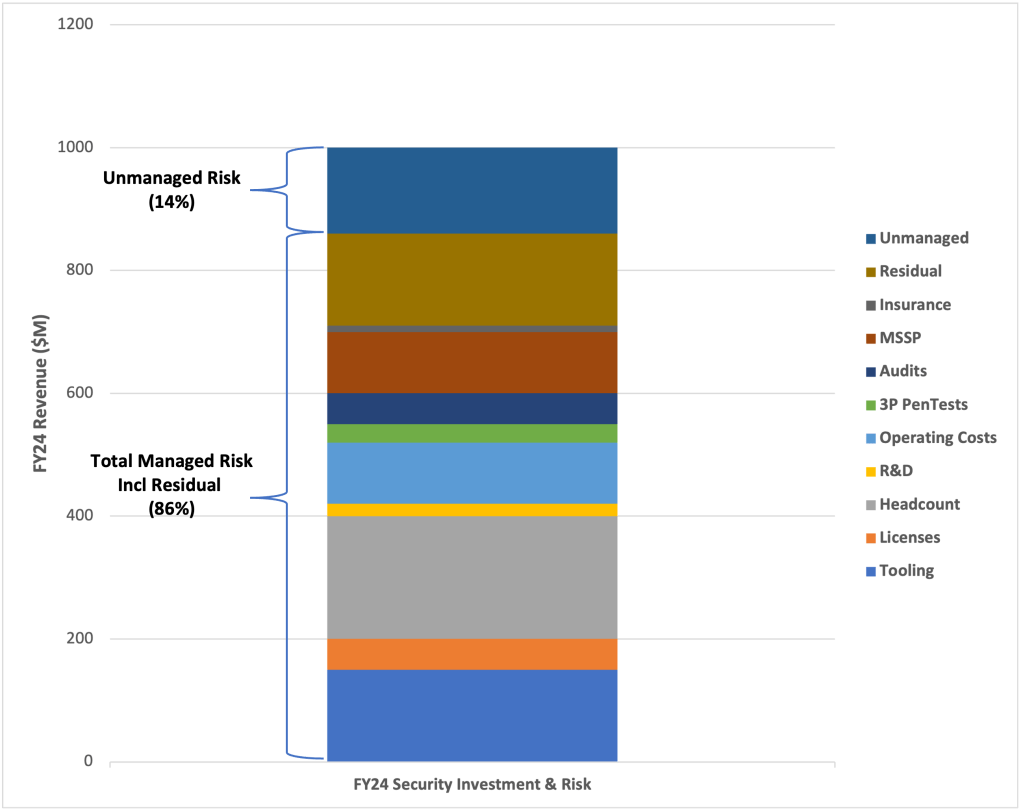
The following chart is an example of what this analysis can yield.

Once you have this data and analysis you can start driving conversations with the rest of the C-Suite and the board to inform them of how much risk is being managed, how much is residual, how much risk is unmanaged and your recommendation for additional investment (or acceptance). These conversations can also benefit from further analysis such as the ratio of cost to managed risk to determine which investment is providing the best value and ultimately support your recommendation for how the company should manage this risk going forward (people or technology).

Wrapping Up

Managing P&L is a fundamental skill for all CISOs to master and can help drive conversations across the company for how risk is being managed. CISOs need to master skills in financial analysis and partner with other parts of the business like business operations or business owners to understand how the business operates and what percentage of the business is effectively covered by the existing security program. The results of this analysis will help CISOs shape the conversation around risk, investment and ultimately the strategic direction of the business.

When Evaluating A New CISO Role Don’t Forget The SEC 10-K And Other Governance Forms

When evaluating a new CISO role it is common to do research on the company, industry, product line, etc., but an area that is often overlooked are SEC filings like the SEC Form 10-K and board committee charters. SEC filings and committee charters can offer a wealth of information about how a company views and governs key issues like cybersecurity and risk. In this post I’ll cover where to find key information, red flags to watch out for and other useful information that can be discussion topics during the interview process.

Finding The Right Forms

If you are new to reviewing SEC filings and corporate governance documents there are a number of places to find documents about corporate governance and how the company strategically views cybersecurity and risk. These documents will provide insight into who you may need to influence in order to execute a successful security program and it will also give you an implicit understanding of the priority the company assigns to cybersecurity issues. The two best places to find relevant forms are on SEC.gov (Edgar) or on the company’s own investor relations website.

SEC Forms

The most common SEC forms you will want to review when preparing for a new CISO role are the SEC Forms 10-K, 10-Q and 8-K.

  • 10-K: The SEC Form 10-K is a comprehensive annual report filed by public companies. It has a wealth of information such as their financials, how they view the market, executive compensation and more. When considering a new CISO role definitely check out section 1 and 1A. Section 1 covers an overview of the business and section 1A covers macro risk factors (you may be asked to help mitigate these risks). Section 1 may also specifically call out cybersecurity governance and have details on the reporting structure, responsibilities, experience and methods for governing cybersecurity at the company. Also check out section 7, which will detail how management describes the company and can also have details on recent acquisitions or restructuring activities, which could continue to present a risk to the business.
  • 10-Q: The SEC Form 10-Q is a comprehensive quarterly report filed by the public company. This will detail their quarterly results and will also provide any updates or changes to the sections I listed above – mainly section 1, 1A and section 7. Most of the time there won’t be any updates to these sections and they will refer back to the 10K, but it is still good to review the latest 10-Q available.
  • 8-K: The SEC Form 8-K is a form companies must file to notify investors of major events. The biggest thing CISO candidates will want to review is if the company has had any material cybersecurity or operational incidents. However, if the company deems an event isn’t material it may not be in the 8-K and so it is a good idea to do a web search of the company as well.
  • Committee Charter Docs: The last set of documents to review are the committee charter documents. This will tell you how the board is structured, which can give you insights into what to expect if you take the role and give periodic updates to the board. The committee charter documents will also outline how they govern cybersecurity, risk and technology and the committee charter documents can give you implicit insight into how the company views the role of the CSO / CISO and cybersecurity.

How Should Cybersecurity Be Governed?

When reviewing the governance and committee documents of a public company, you may find cybersecurity discussed in different places. You should review these documents and also consider discussing cybersecurity governance during the interview process.

Audit committee

The audit committee is the most common committee to govern cybersecurity and risk at a public company. The challenge with placing cybersecurity and risk in the audit committee is the primary function of that committee is financial accuracy and integrity. Cybersecurity and risk are typically listed as “other functions”, which runs the risk of it not having the same priority as financial activities and the committee members may not have the right expertise to govern these functions. The typical executive experience of an audit committee member can be CEO, CFO or COO and these individuals typically aren’t experts in cybersecurity or risk. It isn’t the end of the world, but as a CISO candidate you should review the backgrounds of the audit committee board members and ask how they interact with existing C-Level executives when discussing cybersecurity, technology and risk. You may even want to ask to interview with one of the committee members before taking the job. The main goal is to make sure you are going to get the consideration, prioritization and support you need.

Tech and cyber committee

Aside from the audit committee, the other committee that governs cybersecurity and risk is the technology and cyber committee. However, the existence of this committee is currently non-standard at public companies even though it is considered best practice for corporate governance. If the company you are interviewing has a technology and cybersecurity committee consider yourself fortunate, but you should still do your own due diligence by researching the existing committee members and their backgrounds. Consider requesting an interview with one of these committee members (if it isn’t part of the interview process) to get their perspective on cybersecurity governance and issues at the company.

The challenge with placing cybersecurity and risk in the audit committee is the primary function of that committee is financial accuracy and integrity.

Other Cybersecurity Governance Aspects To Consider

There are a few other aspects to consider when reviewing corporate governance documents. These other areas can give you valuable insight into what is expected of you if and when you assume the role of CISO at the company. First, I recommend covering materiality during the interview process. Ask if the company has a process and if possible discuss their criteria for determining materiality of a security incident. Second, review and assess how often the board committee responsible for cybersecurity meets. This can give you an idea of how often you will be expected to present to the board and may even give you an idea of the topics that are discussed.

Red Flags

The whole point of reviewing these documents is to help you make an informed decision about what you are walking into if you take the role. There are few red flags you should look out for in these documents that should definitely be discussed during the interview to make sure you are clear on your role and expectations. These red flags may also help you when negotiating for things like severance, inclusion in the D&O liability policy or other concessions.

10-K & 10-Q

Remember, the 10-K and 10-Q will have a section on risks and the company may specifically call out cybersecurity risk as a macro issue they are concerned about. However, one red flag I would bring up for discussion is does the company address how they plan to manage these risks? Something as simple as “we plan to discuss and manage these risks inline with business priorities and expectations to minimize their impact” indicates they have at least given it some thought. Even better, if the company has a detailed section on risk and risk management that addresses how they plan to govern the company to address these risks. If the 10-K and 10-Q just list the risks, it may be an indication the company is paying lip service to cybersecurity or it could mean they are waiting for the right candidate to come in and develop a plan.

Experience Of Committee Board Members

Another potential red flag is the background and experience of the board members for the committee that governs cybersecurity and technology risk. Review their background, how long they have been serving on the board and when they are up for re-election. If the committee members have a strong technology or cybersecurity background you can expect to find an ally in the board room. If the committee members haven’t been technology executives you may find you have to change your message or do some education when reporting to the board. The SEC has indicated cybersecurity experience is necessary for the board to effectively govern risks, so if there isn’t clear experience, it is something to bring up in the interview for how and when the company is planning to address the experience gap.

Cybersecurity As Part Of The Audit Committee

I previously mentioned most public companies have cybersecurity listed as an additional function of the audit committee. This can be a red flag if the board doesn’t have committee members with technology experience, but can also be a red flag if the company views the CISO role and security program as more of a compliance function. The view of the board will be directly related to how much funding and support you are able to get from the rest of the company like the CEO and CFO.

Having cybersecurity and risk as part of the audit committee can also lead to a disconnect from the main security program. For example, if the audit committee treats security more as a compliance function, they may request a group that reports directly to them that audits the effectiveness of the corporate security program. This can lead to duplication of effort, cross purposes and mixed messaging at the board level. It can also undermine the authority of the CISO if the board is independently dictating security actions to the company outside of the main security program. However, having cybersecurity as part of the audit committee isn’t the end of the world and can actually lead to support from the board, but it will require additional effort and relationship management to make sure the board is supporting your program effectively. These are all topics you will want to explore during your interview.

Other SEC Filings

There are a few other areas you should review when conducting research for a new CISO position. I highly recommend reviewing recent 8-K filings and conducting internet searches to see if the company has reported any recent security incidents or breaches. If they have, you may be walking into a situation where they need immediate help to get back to a good state, but that support may wane after the urgency of the situation dies down. If you are considering taking a role that is walking into a post incident situation, be really clear on expectations and success criteria and try to build those into your employment contract.

The other area I recommend reviewing is recent or ongoing M&A activity. This will be listed in the 10-K or 10-Q filings for the company and it can give you some insight into what you may be walking into as a CSO / CISO. M&A activity is notorious for “closing the deal” and then sorting everything out later. As a CISO this means you could be inheriting a heterogenous security program or you may have to spend a significant amount of time up-leveling the acquisition to meet the standards of the rest of the company. There may even be extensive integration, standardization, etc. that needs to be completed. All of these are risks that you should be aware of when walking into a new CISO role.

Wrapping Up

When evaluating a new CISO role for a public company I recommend thoroughly researching the company as part of your evaluation process for the role. Familiarize yourself with their business model, the latest news articles, key members of the executive staff, board members and financial statements. If you have a strong CISO network I recommend reaching out to them and getting their perspective on the position. However, overlooked areas of research are the public company filings with the SEC and other investor relations documents that can give you more perspective on the company. It is particularly important to review these documents to get an idea of how the company governs cybersecurity and risk. These documents will also highlight potential red flags and discussion topics to explore during your interview. Thoroughly researching the company and the role will not only help prepare you for the interview process, but can also give you insight into how other public companies govern these issues so you can compare with your current position and make the best decision possible for your career.

Resources

SEC Search

DDN Discussion Of Cybersecurity Governance

Should There Be A Professional CISO Certification and Organization?

I’ve been thinking a lot about the CISO role and how it is rapidly maturing from a technology and compliance role to a more generalized business executive role that specializes in security and risk. The primary catalyst for this evolution is the recent release of the SEC rules requiring companies to report material incidents on their 8K forms. It also requires companies to disclose their process for governing security issues (via committees or other processes) and their process for determining materiality (via their annual 10k filing). All of this is having a similar effect on the CISO role that Sarbanes-Oxley had on the CEO and CFO role after it was passed in 2002. The end result is public companies are now being expected to demonstrate investment and expertise in governing security issues, which is elevating the CISO role to become a true executive officer and is ushering the role into the board room.

Why Did The SEC Establish The New Requirements?

Security reporting and disclosures by public companies has been lacking. There has been zero incentive or accountability for companies to report these events other than via lawsuits, stock price corrections or brand and reputation impact These disclosures often happen as a result of a news report published months or years after the actual incident. The company then issues a generic statement downplaying the event and emphasizing how serious they take security. The SEC has determined this pattern of behavior is insufficient for investors to accurately make decisions about the health of the company.

Why Do Professional Certifications Exist?

Professional certifications exist for a number of reasons. Doctors, accountants. professional engineers and lawyers all must demonstrate a minimum level of knowledge to get licensed in their chosen profession. They must also agree to conduct themselves according to a specific code of conduct. This allows the practitioners to wield specific credentials demonstrating proficiency and credibility in that field. Displaying professional credentials attests these professionals bear the responsibility to protect life, prevent fraud or protect assets.

Additionally, professional credentials afford the practitioners a number of benefits such as knowledge sharing, continual career development, job placement and act as a back stop if someone’s conduct is called into question. Certifying organizations can testify on someone’s behalf if they believe they have upheld the requirements of the profession, or they can self regulate and strip someone of their credentials for fraud or gross negligence.

A short list of fields with professional certifications are as follows:

  • Lawyers – Bar
  • Doctors – Medical license, National Board of Medical Examiners (NBME), State level licenses, American Board of Medical Specialities (ABMS)
  • Accountants – Financial Accounting Standards Board (FASB), Government Accounting Standards Board (GASB), Generally Accepted Accounting Principles (GAAP), Certified Public Accountant (CPA)
  • Engineers – Certified Professional Engineer (CPE)
  • Privacy Professionals – International Association of Privacy Professionals (IAPP)

Existing Security Certifications And Organization Are Lacking

There are already a number of certifications security professionals can choose from on their path to becoming a CISO. A short list of common certifications listed on CISO job postings or LinkedIn profiles is as follows:

  • C|CISO
  • CISSP
  • CISM
  • CISA
  • CRISC

Of these certifications, only the C|CISO certification comes close to offering a specific certification for CISOs. The rest serve either as generalized security certifications or specific offshoots of the security profession. These certifications are often bundled together by professionals to demonstrate breadth of knowledge in the security field.

While existing certifications are good, they are all lacking in what is needed for someone to serve as a CISO at a publicly traded company. They are more generalized about how to serve as a CISO at any company (small to large), but publicly traded companies have specific requirements and demands. Specifically, most of the certifications above are extremely heavy on a breadth of technical aspects and popular industry frameworks. Some of them do cover how to create and manage a security program. Some even cover basic board level conversations (although these are usually technical discussions, which are unrealistic). Where I find these certifications lacking is as follows:

  • Realistic board level conversations about risk and tradeoffs including building effective presentations
  • Board and legal conversations about materiality for security incidents
  • Common board committees and what to expect as a CISO serving on a board level committee for your company
  • Testifying or providing legal evidence post incident
  • Legal conversations about how to best notify customers of breaches including drafting communications
  • Legal conversations with security researchers and navigating vulnerability disclosures
  • How to establish and manage a bug bounty program
  • Navigating conversations with law enforcement or national security issues
  • How to effectively change or strengthen security culture
  • How to have conversations with other C-Suite executives about security
  • Navigating customer and industry requests for disclosure of security program information
  • Managing the budget / P&L for a security function including tooling, licenses, services, travel, expenses, equipment, certifications, etc.
  • Common security team structures and how to design a security org that add maximum value for the business
  • Personnel management, skillsets expected for different roles, matching training and certifications to job function, etc.
  • Negotiating with vendors and cyber insurance companies
  • Contract review and negotiation with customers (including common security and privacy clauses)
  • Creating RFPs, RFIs and RFQs
  • Talking to customers about security at your company or hot button security issues
  • Establishing requirements, conducting trade-off analyses and performing build vs buy analysis
  • How to effectively network with peers
  • Industry resources such as ISACs, Infraguard, etc.
  • Top recruiting agencies for placing CISOs at publicly traded companies
  • Career development post operational CISO (boards, consulting, etc.)
  • Properly documenting your security program
  • How to navigate achieving common compliance certifications such as SOC1, SOC2, FedRAMP, ISO27001, HIPAA, PCI-DSS. Typical costs, consulting companies that can help with these processes and what to expect during the process.
  • When to outsource your security program to an MSP
  • When to bring in an outside consulting or incident response firm
  • Successfully passing an external audit
  • Negotiating for a job including severance, D&O liability, assessing the role, etc.
  • Differences in the CISO role depending on who it reports to (General Counsel, CTO, CIO, CEO, CFO)
  • How to navigate common security related political and moral hazards at public companies

As you can see, there is a big difference between what certifications offer and the real demands of a public company CISO. Additionally, there are a number of professional security organizations such as the Information Systems Security Certification Consortium (ISC2), Information Systems Audit and Control Association (ISACA) and The Council of E-Commerce Consultants (EC-Council). Each has their own certification track, terminology and code of conduct. Each is good in their own right, but there is still a lack of a single certifying body for public company CISOs similar to a CPA. Arguably, ISACA comes closest to being an international organization that can back CISOs, but they lack a CISO specific certification covering the majority of the topics above.

While existing certifications are good, they are all lacking in what is needed to prepare someone to serve as a CISO at a publicly traded company.

Why There Should Be A Professional CISO Certification

The SEC requirements are forcing public companies to govern security to the same standard forced by Sarbanes-Oxley 20 years ago. The SEC considers security to be a material concern to investors and public companies need to treat the issue accordingly. As a result CISOs are getting elevated to the board room and CISOs need to be prepared to navigate the issues they will encounter while serving at a public company.

The advantages of a professional CISO certification and accompanying organization are as follows:

  • Standard of ethics and conduct – CISOs face a difficult job and often walk into roles that aren’t properly supported or properly funded. Yet, CISOs are asked to bear the responsibility and accountability for the security health of the organization. A standard of ethics and conduct, similar to a CPA, will backstop the authority of the CISO and serve as guidelines for how to navigate common issues at publicly traded companies.
  • Standard credential for publicly traded companies – Large companies face a difficult job sorting through the credentials and titles of job applicants. Most public companies hire executive recruiting firms to help navigate the sea of candidates to find ones that are truly qualified for the role. However, a single professional CISO certification would distinguish individuals who have met the standard to be a CISO at a publicly traded company and distinguish these credential holders from other individuals with discretionary CISO titles.
  • Shelter the role from (some) liability – One advantage of a professional certification like the ones for doctors, engineers, lawyers and public accountants is it provides a standard of conduct. These professionals can fall back on this standard of conduct if their professionalism is called into question and they can even have the certifying organization offer testimony on their behalf. As CISO take on more liability, a professional CISO organization can be useful to help support CISOs, testify on their behalf, offer recommendations for liability insurance policies or even provide low cost liability insurance through the organization. They can even help review employment contract terms to evaluate liability policies, severance, legal coverage, etc.
  • Board Level Expertise – One of the primary roles of public company CISOs is to present to the board and help the company navigate regulatory and compliance requirements such as SEC filings, breach notifications, etc. A professional CISO certification offer individuals this experience and it can give them the confidence to speak to the board on how to navigate topics of risk. By certifying individuals are qualified to operate in the board room the board will gain another voice to balance the other C-Suite executives who aren’t grounded in technology and security issues.
  • Consulting and auditing – One final advantage of a professional CISO certification is for the “big 4” consulting firms or other agencies who are contracted by investment companies to audit and certify the filings and reports of public companies. In this case, a certified CISO can represent shareholders and investors for the accuracy of security filings around governance processes, representation in board committees, recommendations for appropriate investment in security governance and generally offering advice on industry best practices for security governance at publicly traded companies.

Wrapping Up

I’m bullish on the CISO role long term because I think it is the ultimate C-Suite executive. Public company CISOs touch all aspects of the business, they need to have strong technical chops, need to understand business topics and need to have the political chops to build alliances and navigate big company politics. Existing security certifications are good, but none of them offer a comprehensive breadth of topics to prepare individuals to become a CISO at a publicly traded company. As CISOs establish their role and credibility in the board room, it will become critical for these individuals to have credentials that back their experience, offer support and can elevate the CISO role on par with other C-Level execs, similar to what Sarbanes-Oxley did for CFOs after 2002.