Navigating The First 90-180 Days In A New CISO Role

Late one Friday afternoon a call comes in and you find out you landed your next CISO role. All the interview prep, research, networking and public speaking has paid off! Then it dawns on you that you could be walking into a very difficult situation over the next few months. Even though the interview answered a lot of questions, you won’t know the reality of the situation until you start. How will your expectations differ from reality? What can you do to minimize risk as you come up to speed? How should you navigate these first 90-180 days in your new role?

Prior To Starting

Let’s assume you have some time to wind down your current position and you are also going to take some time off before starting the new role. During this transition period I highly advise you reach out to your peers in the new role and start asking questions to get more detail about the top challenges and risks you need to address. Start with the rest of the C-Suite, but also get time with board members and other senior business leaders to get their perspectives. Focus on building rapport, but also gather information to build on what you learned during the interview process so you can hit the ground running.

You can also use this time to reach out to your CISO peers in your network who are in the same industry, vertical or company type to get their perspective on what they did when they first joined their company. Learn from their experience and try to accelerate your journey once you start. Keep the lines of communication open so if you run into a situation you are unsure of you can ask for advice.

Once You Start

Build Relationships

First and foremost, start building relationships as quickly as possible. Target senior leadership first, such as board members, the C-Suite and other senior leaders. Work your way down by identifying key influencers and decision makers throughout the org. Play the “new person card” and ask questions about anything and everything. Gain an understanding of the “operational tempo” of the business such as when key meetings take place (like board meetings). Understand the historical reasons why certain challenges exist. Understand the political reasons why challenges persist. Understand the OKRs, KPIs and other business objectives carried by your peers. Learn the near and long term strategy for the business. Start building out a picture of what the true situation is and how you want to begin prioritizing.

Understand the historical reasons why certain challenges exist. Understand the political reasons why challenges persist.

Plan For The Worst

Don’t be surprised if you take a new role and are immediately thrown into an incident or other significant situation. You may not have had time to review playbooks or processes, but you can still fall back on your prior experience to guide the team through this event and learn from it. Most importantly, you can use this experience to identify key talent and let them lead, while you observe and take notes. You can also use your observation of the incident to take notes on things that need to be improved such as interaction with non-security groups, when to inform the board, how to communicate with customers or how to improve coordination among your team.

Act With Urgency

Your first few months in the role are extremely vulnerable periods for both you and the company. During this period you won’t have a full picture of the risks to the business and you may not have fully developed your long term plan. Despite these challenges, you still need to act with urgency to gain an understanding of the business and the risk landscape as quickly as possible. Build on the existing program (if any) to document your assumptions, discoveries, controls and risks so you can begin to litigation proof your org. Map the maturity of security controls to an industry framework to help inform your view of the current state of risk at the company. Begin building out templates for communicating your findings, asks, etc. to both the board and your peers. Most importantly, the company will benefit from your fresh perspective so be candid about your findings and initial recommendations.

Evaluate The Security Org

In addition to the recommendations above, one of the first things I like to do is evaluate the org I have inherited. I try to talk to everyone and answer a few questions:

  1. Is the current org structure best positioned to support the rest of the business?
  2. How does the rest of the business perceive the security org?
  3. Where do we have talent gaps in the org?
  4. What improvements do we need to make to culture, diversity, processes, etc. to optimize the existing talent of the org?

Answering these questions may require you to work with your HR business partner to build out new role definitions and career paths for your org. You may also need to start a diversity campaign or a culture improvement campaign within the security org. Most importantly, evaluate the people in your org to see if you have the right people in the right places with the right skillsets.

A Plan Takes Shape

As you glide past the 90 day mark and start establishing your position as a trusted business partner, you should arrive at a point where a clear vision and strategy is starting to take shape. Use the information you have gathered from your peers, your program documentation and your observations to start building a comprehensive plan and strategy. I’ve documented this process in detail here. In addition to building your program plan you can also begin to more accurately communicate the state of your security program to senior leaders and the board. Show how much the existing program addresses business risk and where additional investment is needed. I’ve documented a suggested process here. Somewhere between your 90 and 180 day mark you should have a formalized plan for where you are over invested, under invested or need to make changes to optimize existing investment. This could include restructuring your org, buying a new technology, adjusting contractual terms or purchasing short term cyber insurance. It could even include outsourcing key functions of the security org for the short term, until you can get the rest of your program up to a certain standard. Most importantly, document how you arrived at key decisions and priorities.

Take Care Of Yourself

Lastly, on a personal note, make sure to take care of yourself. Starting a new role is hectic and exciting, but it is also a time where you can quickly overwork yourself. Remember building and leading a successful security program is a marathon not a sprint. The work is never done. Get your program to a comfortable position as quickly as possible by addressing key gaps so you can avoid burning yourself out. Try to establish a routine to allow for physical and mental health and communicate your goals to your business partners so they can support you.

During this time (or the first year) you may also want to minimize external commitments like dinners, conferences and speaking engagements. When you start a new role everyone will want your time and attention, but be cautious and protective of your time. While it is nice to get a free meal, these dinners can often take up a lot of time for little value on your end (you are the product after all). Most companies have an active marketing department that will ask you to engage with customers and the industry. Build a good relationship with your marketing peers to interweave customer commitments with industry events so you are appropriately balancing your time and attending the events that will be most impactful for the company, your network and your career.

Wrapping Up

Landing your next CISO role is exciting and definitely worth celebrating. However, the first 90-180 days are critical to gain an understanding of the business, key stakeholders and how you want to start prioritizing activities. Most importantly, build relationships, act with urgency and document everything so you can minimize the window of exposure as you are coming up to speed in your new role.

Build A Proactive Security Program By Focusing On The Fundamentals

A common topic at security conferences, CISO dinners and networking events is: “how you are preparing your program for a new and upcoming regulation?” For CISOs, this conversation is a way to exchange ideas, gather information and compare programs. Unfortunately, CISOs often express feeling underprepared for the upcoming shift in the regulatory landscape causing them to scramble to meet the new requirements. I’m sure this feeling has existed since the first CISO role was created and has been continuing through SOX, PCI-DSS, HIPAA, GDPR, DORA and CMMC. If you have ever felt your program can be better prepared for new challenges or are looking to be more proactive then this post is for you. The goal is to prepare your security program so well that any new challenges are a non-event and I fundamentally believe there are lots of things CISOs can do with their security programs to achieve this goal.

What Causes Programs To Be Reactive?

Underfunding

There are several issues that can cause a security program to be reactive and understanding the problem is the first step to over coming it. One of the most common issues with any security program is underfunding. Underfunding a security program can have ripple effects on staff, technology, risk management and compliance activities. Underfunding can be a conscious choice of the business, but more often it is the result of the CISO failing to articulate or demonstrate how the security program creates value for the business. If you can’t link your security program back to business objectives and risk then your program is falling short. When a program is underfunded it can’t innovate or gain breathing room. As a result the program will be in a perpetual state of reactivity and constantly responding to the next problem that comes up.

Poor Understanding Of Risk

But wait! You say. My program is well funded. I have the staff and technology I need, but we are still reactive. This can be for a few other reasons, such as your program has a poor understanding of the risk landscape for the business. At a basic level this means documenting your program, controls, policies, exceptions and strategy so you are in lock step with what the business is trying to accomplish. The culture of the security program should be “help me say yes to your security ask”, instead of always saying no.

Thoroughly understanding the risk landscape for the business, such as where your security program effectively manages that risk and where the business can take on more risk, is critical to helping the business operate, expand and be successful. If you haven’t mapped your program to risk then your program will always be reactive because you will have to constantly evaluate the changing business conditions each time slowing down the business and pulling resources from other areas.

Shiny Thing Syndrome

One final reason your security program can be reactive is shiny thing syndrome. This is where someone in the org (it can be you, the CTO, the CEO, etc.) is constantly enamored with new technology, things they read in Harvard Business Review or whatever they think is “cool”. This means your program will constantly lurch from thing to thing without ever gaining momentum. It also means instead of following a clear and well laid out strategy and roadmap, your program will hop around and never achieve success. They best way to counter shiny thing syndrome is with a well documented program, with a clear understanding of where you are and where you are going.

Shifting To Become Proactive

So the big question is: how do you shift your program to become proactive? We can talk about a lot of ideas like automation, AI, processes, etc., but I truly believe the core of any security program should be the fundamentals and by focusing on these fundamentals you can stop being reactive.

Don’t Practice During The Game

Here is an analogy that I like to use for what a proactive security program means. Consider you are learning to play baseball. You could go out into the field look around and hope the ball doesn’t get hit to you. Worse, you could have no idea which way to face, what to do with the glove or even how to win the game. You are just standing there… waiting to react to whatever happens and hoping to figure it out. This is a security program that hasn’t mastered the fundamentals.

However hope is not a strategy and you shouldn’t practice your skills at the game. You should practice the skills you need before the game, hone them over and over until they become instinctive allowing you to proactively shift your strategy during the game. This is what a proactive security program can do. By focusing on the fundamentals like knowing what you have, where it is and what the status is, you know you won’t have to scramble to figure these things out when a new regulation comes out or a new incident hits. By thoroughly documenting your program against an industry standard framework and continually measuring compliance and risk against that framework you will eventually master the fundamentals and become proactive. Focusing on and mastering the fundamentals allows you to continually refine your program so you can anticipate where the business, industry and regulatory environment is going. In fact, any changes in the business, industry or regulatory environment should be a non-event because your program is so robust that you can help the business take on and manage whatever new risk comes up.

Wrapping Up

Next time you are faced with a challenging incident, new regulation, new compliance activity or are at odds with the business, ask yourself if your program has mastered the fundamentals. Do an honest assessment of your program, conduct a retrospective of past activities and assess where you need to improve. Find new ways to articulate the value of your program and link your program back to business risk so you can get the funding and support you need. By mastering the fundamentals you are mastering important skills when it doesn’t matter, so you can be proactive and anticipate events before they matter.

Is Agile and DevOps Holding Back Your Security Program?

There are a variety of development models you can run into as a CISO. If you are in the defense or government sector your engineering teams will probably use something like waterfall. However, if your company produces software products or services then most likely your organization uses Agile or SAFe and DevOps as the core development methodologies. Most companies have shifted to Agile over the past decade due to the ability to break work into smaller chunks, iterate and get products to market faster. They have also shifted to DevOps, where the teams that build the thing are also the team that operates and maintains it. However, there are some disadvantages to using Agile and DevOps methodologies and as a CISO you should be familiar with the negative aspects and how to deal with them.

When DevOps Isn’t

If your engineering and development teams aren’t very mature, or if there is an imbalance between engineering, product management and sales, your Agile development and DevOps models can become skewed too far towards new feature development at the expense of all else. If this happens the security organization will find it difficult to inject security priorities into the sprints. This can cause a build up of tech debt, which can heavily impact security roadmaps.

For example, if one of your main development platforms needs to be upgraded to the latest version in order to make a new security feature available, then this will need to be prioritized and planned for within the sprints. Ideally, you can do this upgrade without any down time, but that isn’t always the case. If dev teams don’t have any slack in their sprints for operational maintenance, such as upgrades, refactoring code, improving observability, improving reliability or practicing good fundamentals, then tech debt will build up over time and the security org will find it difficult to advance their roadmap and effectively manage risk.

If you are finding your dev and engineering teams aren’t allowing enough time for DevOps activities then it is worthwhile to go back to the fundamentals and develop a RACI for who is responsible for the different tasks required to operate and maintain your products and services. Set clear expectations and metrics to measure teams. Often, when the DevOps model is broken there is a weak sense of ownership and dev teams need to be reminded that they need to maintain the things they build. You may also need to spend time with your Chief Product Officer, Chief Technology Officer or your Chief Revenue (Sales) Officer to set expectations and get their support to change the behavior of the engineering teams and how they interact with product or sales. Ultimately, good reporting that can reveal patterns of behavior, backlogs, tech debt and lack of fundamentals will go a long way to articulating the problem set and enlisting the support of the rest of the C-Level to fix the broken DevOps model.

When Agile Becomes An Excuse

Similar to the example above, Agile methodologies can become an excuse for engineering teams to not prioritize security requests such as code fixes, library updates, software patches and vulnerability remediation. Your security org may start to recognize this problem if the engineering teams never insert your activities into the sprints or if they over estimate how long it will take to complete your security request (a common delaying tactic).

When Agile becomes an excuse for dev teams it can help to have security champions or product security specialists that embed with the engineering teams to champion security priorities and make sure they get included in the appropriate sprint to hit the milestone or deadline. Often, engineering teams just don’t understand the activity and having a security expert embedded in the team can help remove the FUD (fear, uncertainty and doubt) and get the teams comfortable with including and completing security priorities. Once this muscle gets exercised enough and the engineering teams are showing consistent performance, the security champions can move on to another team that needs more help.

When dev teams are using Agile as an excuse there can be a variety of reasons such as lack of maturity or over prioritization of features over all else. This is where good metrics such as sprint velocity, capacity and estimation accuracy can help. Measuring these metrics over time and discussing them at the executive level can help identify teams that need help or are consistently under performing. This can be important for a CISO who is trying to get security priorities inserted into the team. Understanding where an engineering team is on the maturity scale and using clear metrics to report on their performance can help shift priorities as needed.

One thing you absolutely should not do as an executive team is assign engineering teams percentages of work, such as “spend 20% of your time on security activities”. This is a recipe for disaster because unless the work going into the 20% is clearly agreed on, engineering teams may use any type of work they think is security work to include in the 20%. This will cause a serious disconnect between security and the engineering teams because engineering will point out they are spending 20% of their time doing security stuff, but security won’t be getting the priorities they need. Instead of assigned percentages, it is better to have dynamic sprints where work is pulled in based on their priority with clear criteria, such as risk or revenue, that can help teams fill their sprints appropriately.

When MVP Isn’t Good Enough

Lastly, Agile is a really good methodology for building products that can iterate and develop functionality over time. It is rare that these are mission critical products and instead are products that are launched with a small feature set or core service that expands in functionality over time. However, when it comes to mission critical products, like security products, Agile and the MVP (minimum viable product) just won’t cut it. The reality is unless you have a really robust MVP, you will most likely need a GA (general availability) of the product before it has the type of functionality you need for your security program. Understanding the limitations of Agile and how to negotiate when you will get the features you need is important for organizations that build their own products internally or for organizations that partner closely with external companies to build custom products or develop products in tandem.

Whenever I interface with a team that plans to build a security product internally or with a company that is developing a custom product for my group I make sure I am extremely clear about the features and functionality I need before I will adopt the product. Often, I will compare the product in development with other existing products or I will perform extensive testing of the new product based on real world scenarios. However your security team decides to verify and validate the new thing, make sure your requirements are clear and your testing is repeatable. Document every decision and for external partners consider contract language that can protect you if the full functionality of the product or service isn’t working after you buy. Most importantly, don’t buy or renew based on promises from an external partner. If it doesn’t exist when you buy, it will be tough to get them to prioritize your requests after you hand over the check.

Wrapping Up

I’ve covered a few scenarios where Agile and DevOps can go wrong and ultimately hold back your security program. If this happens it is important to recognize the behavior and develop tactics to correct the issue. This can involve setting expectations with your C-Suite counterparts, developing clear RACI models with engineering teams or clearly documenting functionality required for a security purchase. Whatever the issue, measuring and monitoring performance will help to articulate any issues you run into and build strong relationships between security and the engineering (DevOps) teams.

How CIOs, CTOs and the rest of the C-Suite Can Better Support CISOs

There are a variety of reporting structures for CISOs, such as reporting to the CTO, CIO, CFO or CEO. No matter who the CISO reports to, the CISO is still an integral part of the C-Suite. Yet despite this, CISOs don’t always receive full support from the rest of their C-Suite peers, which can cause friction and open up the business to risk. In this post I’ll cover how the rest of the C-Suite can better support their CISO peers and how doing so will actually help them achieve their goals as well.

Strategic Planning

First and foremost, the CISO needs to be included in strategic planning sessions about new markets, mergers and acquisitions (M&A), divestitures, new product launches and new customer types. Each of these areas will create new security risks and regulatory requirements that can have lengthy lead times for addressing. The CISO needs to be informed about product roadmaps, new features and new technology initiatives. If the CISO and security group are left out of these strategic discussions the business could be forced to delay a new business opportunity or worse enter the new opportunity without properly managing the risks.

Master The Fundamentals

Second, CTOs and CIOs need their teams to master and execute on the fundamentals. This means things like asset inventory, logging, observability, QA, QC and operations support (event notification and cost analysis). The reality is the rest of the business needs these things and these are not problems the CISO should own, yet if they are not in place they will cripple a security program. For this reason, a lot of CISOs will try to tackle these issues, but they won’t be successful without support from the C-Suite that actually owns these functions. So, one of the best ways the CTO and CIO can support the CISO is to lead the way on the heavy lifting for these fundamentals that way the CISO can draft off of these and focus on making their security program as effective as possible to manage risk.

Accountability

Speaking of mastering the fundamentals, what we are really talking about is accountability. The rest of the C-Suite needs to hold their teams accountable for completing or resolving security issues. This could be things like resolving technical debt, completing training, fixing vulnerabilities or appropriately prioritizing security requests. If accountability isn’t enforced at the C-Suite, then the rest of the business will become siloed and ignore other initiatives across the company. This can cause security issues to pile up and open up the business to risk that will be impossible for the CISO to manage. By holding your teams accountable and partnering with the CISO function you will create a partnership that can accelerate the business instead of creating unnecessary friction.

One easy way to get visibility into what your teams are doing, so you can drive accountability, is with an exceptions process. Exceptions are a common process for a security function and it allows the security team to have escalating levels of approval based on risk. It also allows for reporting and metrics about how many exceptions a team has requested, how many have been approved and how long it takes the team to resolve an exception. This can provide other C-Suite members valuable insights into how their function is performing with respect to their security commitments and it also allows the C-Suite to drive accountability into their functions by acting as the senior executive approver for critical risks in their function.

An exceptions process doesn’t have to be just for security. The entire company can benefit from an exceptions process such as for purchasing, contracts, sales, finance and engineering. Exceptions across the company can give visibility, promote good friction and drive accountability.

Support Good Friction

There are two different types of friction in a company and we have all experienced them. Good friction exists to help slow people down to consider their actions or minimize risk. These are processes like confirming large financial transactions or requiring validation of someone’s identity before using a critical resource. Bad friction wastes people’s time and is adversarial. These are processes that are inefficient, people that exercise unnecessary control over others or people that never follow through on activities. This type of friction needs to be avoided.

The rest of the C-Suite can support the creation of good friction with respect to security and how security engages with their teams. Good friction can actually accelerate the business by front loading activities where they will take less time, instead of trying to resolve issues later in the lifecycle where they are incredibly difficult and expensive to resolve. Some examples of good friction are security checks as part of the CI/CD pipeline, like SAST, automated attack simulation, or automated compliance reviews. When the rest of the C-Suite supports good friction it will actually make everyone’s job easier and less risky.

Help Advocate For Security

Another way the rest of the C-Suite can support the CISO is by helping to advocate the value of the security function beyond being an insurance policy or compliance function. While the security function may be viewed as a cost center, it can actually drive revenue and generate value. By including the CISO in the strategic planning process, CISOs can advocate product features with customers and engage with customers in a more proactive way. CISOs can also work with the go to market and finance teams to create processes for tracking customer engagements by the security team. This can shed light into the direct and indirect ways the security function is driving revenue, which can change the perspective of the security function from simply being a cost center. Having other C-Suite members advocate and support the CISO with customer engagements, building revenue tracking and involving the security team in all phases of the business can help improve the value of security and reduce overall risk.

Cultural Change

The last area the C-Suite can help the CISO with is cultural change. The Chief People Officer or Chief HR officer can work with the CISO to create and adapt comp structures for the security team that reflects the competitiveness of the market. They can also work with the CISO to create career paths, training and job specific performance metrics for the security function. The Chief People Officer and the HR function are also critical partners for the CISO to backstop security policies and enforce these policies across the company. HR can create and enforce consequences for policy violations, such as lack of eligibility for promotion, and they can also help manage the worst offenders with termination. HR can also set incentives to reward good security behavior such as giving spot bonuses, rapid promotions or even tying bonuses to completion of key security goals.

Outside of the culture of the security function, the rest of the C-Suite can set the tone for the culture with respect to how the company should view and engage with security. In particular, the C-Suite can lay the foundation for a security first culture and hold people accountable for implementing this throughout their functions. They can also shift the culture by holding business owners accountable for the things they own. Lastly, if the rest of the C-Suite carries KPIs, OKRs or other annual performance metrics as part of their annual goals this can help cross pollinate and incentivize the entire company to execute on effectively managing risk.

Wrapping Up

Close partnership with the rest of the C-Suite is essential for the CISO to be successful. The rest of the C-Suite can support the CISO and the security function by involving the CISO in strategic planning, driving accountability, mastering the fundamentals, supporting good friction, advocating for security and helping to drive cultural change. By supporting these areas, the rest of the C-Suite will set the tone from the top and work with the CISO to govern the risk of the business in a way that allows it to eliminate bad friction, accelerate growth and remain competitive.

How Should CISOs Think About Risk?

There are a lot of different ways for CISOs to think about and measure risk, which can be bucketed into two different categories. Qualitative measurement, which is a subjective measurement that follows an objective process or quantitative measurement, which is an objective measurement grounded in dollar amounts. Quantitative risk measurement is what CISOs should strive to achieve for a few reasons. One, it grounds the risk measurement in objective numbers which removes people’s opinions from the calculation; two, it assesses risk in terms of dollar amounts, which is useful for communicating to the rest of the business; and three, it can highlight areas of immaturity across the business if they are unable to quantify how their division contributes to the overall bottom line of the company. In this post I want to explore how CISOs should think about quantitatively measuring risk and in particular, measuring mitigated, unmitigated and residual risk for the business.

Where should you start?

A good place to start is with an industry standard risk management framework like NIST 800-37, CIS RAM or ISO 31000 and for the purposes of this post I’ll stick with the NIST 800-37 to be consistent. In order for CISOs to obtain a qualitative risk assessment from the NIST 800-37 they need to add a step into the categorize step by working with finance and the business owners to understand the P&L of the system(s) they are categorizing. The first step is to go through every business system and get a dollar amount (in terms of revenue) for how much the systems(s) contribute to the overall bottom line of the business.

Internal and External Security Costs

After you get a revenue dollar amount for every set of systems, you now need to move to the assess stage of the NIST 800-37 RMF to determine which security controls are in place to protect the systems, how much they cost and ultimately what percentage the security controls cover. There are two categories of security controls and costs you will need to build a model for. The first category is internal costs, which includes:

  • Tooling and technology
  • Licenses
  • Training
  • Headcount (fully burdened cost)
  • Travel
  • R&D
  • Technology operating costs (like cloud costs directly attributable to security tooling, etc.)

The second category is external costs, which includes:

  • 3rd party penetration tests
  • Audits
  • Managed Security Service Provider (MSSP) costs
  • Insurance

As you fill in the costs or annual budget for each of these items you can map the coverage of these internal and external costs to your business to determine the total cost of your security program and how much risk the program is able to cover (in terms of a percentage).

Mapping Risk Coverage

Once you have all of these figures you can start to map risk coverage to determine if your security program is effectively protecting the business. Let’s say your business generates $1B in annual revenue. Your goal as a CISO is to maintain a security program that provides $1B of risk coverage of the business. Or, if you are unable to provide total coverage, then you need to communicate which parts of the business are not protected so the rest of the C-Suite and board can either accept the risk or approve additional funding.

As a simple example, let’s say you spend $1M/year on a SIEM tool, which takes 6 people to operate and maintain. The total cost of the 6 people is approximately $6M / yr (including benefits, etc.). The SIEM and people provide 100% monitoring coverage for the business and the SIEM and people can be mapped to 20% of your security controls in NIST. I’m skipping a lot of details for simplicity, but for a $1B business this means your SIEM function costs $7M / yr, but protects $200M of revenue ($1B x 20%). As you map the other tools, processes, people, etc. back to the business you will get a complete picture of how much risk your security program is managing and make informed decisions about your program to the board.

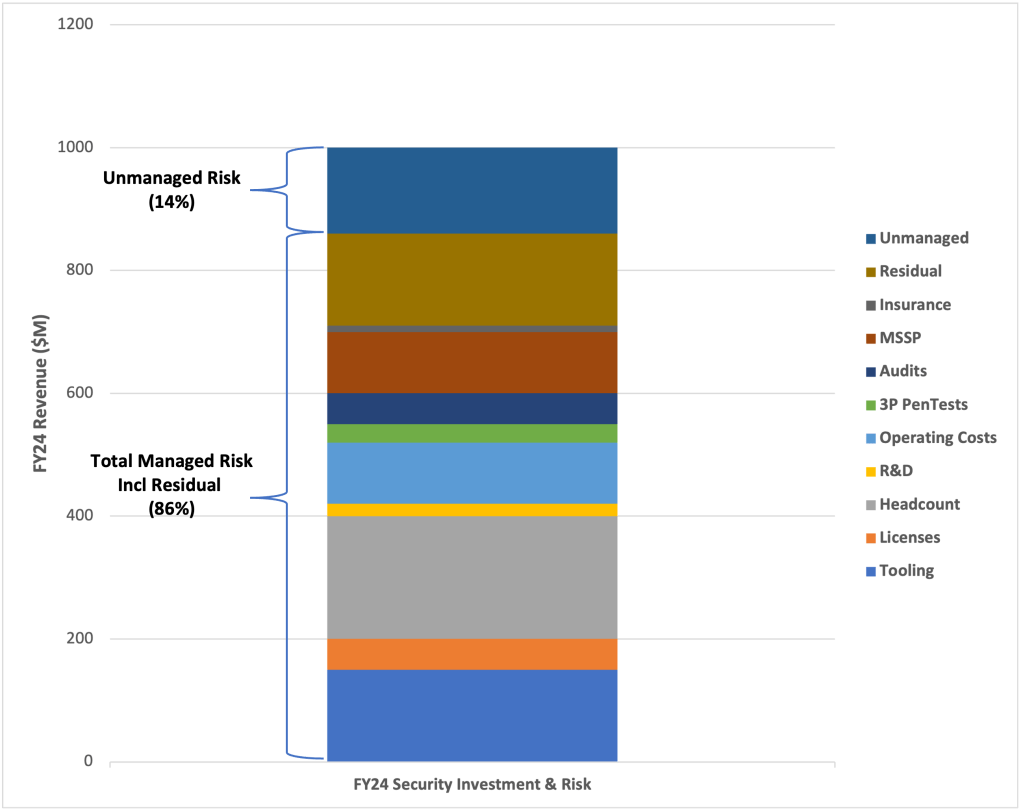
For example, you may find your security program costs $100M / year, but is only able to manage risk for $750M (75%) of the business. Your analysis should clearly articulate whether this remaining 20% of risk is residual (will never go away and is acceptable) or is unmanaged and needs attention.

Complete The Picture

By mapping your security program costs to the percentage of controls they cover and then mapping those controls to the business, CISOs should be able to get an accurate picture of the effectiveness of their security program. By breaking out the security program costs into the internal and external categories I’ve listed above, they can also compare and contrast the costs to the total amount of risk to determine which investments yield the best value. These analyses can be extremely effective when having conversations with the rest of the C-Suite or board, who may be inclined to decline additional budget requests or subjectively recommend a solution. By informing these stakeholders of the cost per control and the risk value of that cost, you can help them support your recommendation for additional investment to help increase risk management coverage or to help increase the value of risk management provided by the security program.

The following chart is an example of what this analysis can yield.

Once you have this data and analysis you can start driving conversations with the rest of the C-Suite and the board to inform them of how much risk is being managed, how much is residual, how much risk is unmanaged and your recommendation for additional investment (or acceptance). These conversations can also benefit from further analysis such as the ratio of cost to managed risk to determine which investment is providing the best value and ultimately support your recommendation for how the company should manage this risk going forward (people or technology).

Wrapping Up

Managing P&L is a fundamental skill for all CISOs to master and can help drive conversations across the company for how risk is being managed. CISOs need to master skills in financial analysis and partner with other parts of the business like business operations or business owners to understand how the business operates and what percentage of the business is effectively covered by the existing security program. The results of this analysis will help CISOs shape the conversation around risk, investment and ultimately the strategic direction of the business.

Should CISOs Be Technical?

Don’t want to read this? Watch a video short of the topic here.

There are a lot of different paths to becoming a CISO and everyone’s journey is different, however two of the most common paths are coming up through the technical ranks or transitioning over from the compliance function. Coming up through the technical ranks is common because cybersecurity is a technically heavy field, particularly when attempting to understand the complexities of how exploits work and the best way to defend against attackers. Coming up through the compliance ranks is also common because companies are often focused on getting a particular compliance certification in order for them to conduct business and interact with the customers. Each of these paths offers advantages and disadvantages, but I will argue being technical is more challenging than some of the softer cybersecurity disciplines like compliance, which leads to a common question – do CISOs need to be technical?

Yes, but…

If you don’t want to read any further the short answer is yes, CISOs need to be technical. The longer answer is, being technical is a necessary, but insufficient characteristic of a well rounded CISO. The reason being technical is insufficient is because for the past few years the CISO role at public companies has been transforming from a technical role to a business savvy executive role. CISOs are expected to report to the board, which requires speaking the language of business, risk and finance. I have seen CISOs quickly lose their audience in board meetings when they start talking about tooling, vulnerabilities and detailed technical aspects of their security program. CISOs need to be able to translate their security program into the language of risk and they need to be savvy enough to weave in financial and business terminology that the board and other C-Suite executives will understand.

Obtain (and maintain) A Technical Grounding

Even though being technical is no longer sufficient for a well rounded CISO it is important for a CISO to obtain or maintain a technical grounding. A technical grounding will help the CISO translate technical concepts (like vulnerabilities and exploits) into higher level business language like strategy, risk or profit and loss (P&L). It is also important for a CISO to understand technical concepts so they can dig in when needed to make sure their program is on track or controls are operating effectively. Lastly, it is important to maintain technical credibility with other technical C-Suite stakeholders like the CTO and CIO. Speaking their language will help align these powerful C-Suite members with your security program, who can then lend critical support when making asks for the rest of the C-Suite or board.

What other skills does a CISO need?

In addition to a technical grounding, there are a number of skills CISOs need to master in order to be effective in their role. The following is a short list of skills CISOs need to have in order to be successful at a public company:

  • Executive presence and public speaking skills with the ability to translate security concepts into business risk that resonates with senior executives and the board
  • Ability to lead and communicate during a crisis
  • Politically savvy, with ability to partner with and build alliances with other parts of the business
  • Ability to understand the core parts of the business, how they operate and what their strategy is
  • Ability to explain the “value” of your security program in business and financial terms
  • Strong understanding of financial concepts such as CAPEX, OPEX, P&L, budgeting and ability to understand balance sheets, earning results and SEC filings
  • Understand and navigate legal concepts (such as privilege), regulations and compliance activities with the ability to map these concepts back to your security program or testify in court (if needed)
  • Ability to interact with auditors (when needed) to satisfy compliance asks or guide responses
  • Ability to interact with customers to either reassure them about the maturity of your security program or act as an extension of the sales team to help acquire new customers
  • Interact with law enforcement and other government agencies, depending on the nature of the business

If this seems like a long list that doesn’t fit your concept of what a CISO does, then you may have some weaknesses you need to work on. This list also reflects the evolving nature of the CISO role, particularly with respect to board interaction and leadership at public companies. More importantly, a lot of these concepts are not covered in popular security certifications and you definitely won’t get all of this experience from start ups or non-public companies. That is ok, because recognizing and acknowledging your weaknesses is the first step to becoming a better CISO.

Navigating Hardware Supply Chain Security

Lately, I’ve been thinking a lot about hardware supply chain security and how the risks and controls differ from software supply chain security. As a CSO, one of your responsibilities is to ensure your supply chain is secure, yet the distributed nature of our global supply chain makes this a challenging endeavor. In this post I’ll explore how a CSO should think about the risks of hardware supply chain security, how they should think about governing this problem and some techniques for implementing security assurance within your hardware supply chain.

What Is Hardware Supply Chain?

Hardware supply chain relates to the manufacturing, assembly, distribution and logistics of physical systems. This includes the physical components and the underlying software that comes together to make a functioning system. A real world example could be something as complex as an entire server or something as simple as a USB drive. Your company can be at the start of the supply chain by sourcing and producing raw materials like copper and silicon, at the middle of the supply chain producing individual components like microchips, or at the end of the supply chain assembling and integrating components into an end product for customers.

What Are The Risks?

There are a lot of risks when it comes to the security of hardware supply chains. Hardware typically has longer lead times and longer shelf life than software. This means compromises can be harder to detect (due to all the stops along the way) and can persist for a long time (e.g. decades in cases like industrial control systems). It can be extremely difficult or impossible to mitigate a compromise in hardware without replacing the entire system (or requiring downtime), which is costly to a business or deadly to a mission critical system.

The risk of physical or logical compromise can happen in two ways – interdiction and seeding. Both involve physically tampering with a hardware device, but occur at different points in the supply chain. Seeding occurs during the physical manufacture of components and involves someone inserting something malicious (like a backdoor) into a design or component. Insertion early in the process means the compromise can persist for a long period of time if it is not detected before final assembly.

Interdiction happens later in the supply chain when the finished product is being shipped from the manufacturer to the end customer. During interdiction the product is intercepted en route, opened, altered and then sent to the end customer in an altered or compromised state. The hope is the recipient won’t detect the slight shipping delay or the compromised product, which will allow anything from GPS location data to full remote access.

Governance

CSOs should take a comprehensive approach to manage the risks associated with hardware supply chain security that includes policies, processes, contractual language and technology.

Policies

CSOs should establish and maintain policies specifying the security requirements at every step of the hardware supply chain. This starts at the requirements gathering phase and includes design, sourcing, manufacturing, assembly and shipping. These policies should align to the objectives and risks of the overall business with careful consideration for how to control risk at each step. An example policy could be your business requires independent validation and verification of your hardware design specification to make sure it doesn’t include malicious components or logic. Or, another example policy can require all personnel who physically manufacture components in your supply chain receive periodic background checks.

Processes

Designing and implementing secure processes can help manage the risks in your supply chain and CSOs should be involved in the design and review these processes. Processes can help detect compromises in your supply chain and can create or reduce friction where needed (depending on risk). For example, if your company is involved in national security programs you may establish processes that perform verification and validation of components prior to assembly. You also may want to establish robust processes and security controls related to intellectual property (IP) and research and development (R&D). Controlling access to and dissemination of IP and R&D can make it more difficult to seed or interdict hardware components later on.

Contractual Language

An avenue CSOs should regularly review with their legal department are the contractual clauses used by your company for the companies and suppliers in your supply chain. Contractual language can extend your security requirements to these third parties and even allow your security team to audit and review their manufacturing processes to make sure they are secure.

Technology

The last piece of governance CSOs should invest in is technology. These are the specific technology controls to ensure physical and logical security of the manufacturing and assembly facilities that your company operates. Technology can include badging systems, cameras, RFID tracking, GPS tracking, anti-tamper controls and even technology to help assess the security assurance of components and products. The technologies a CSO selects should complement and augment their entire security program in addition to normal security controls like physical security, network security, insider threat, RBAC, etc.

Detecting Compromises

One aspect of hardware supply chain that is arguably more challenging than software supply chain is detection of compromise. With the proliferation of open source software and technologies like sandboxing, it is possible to review and understand how a software program behaves. Yet, it is much more difficult to do this at the hardware layer. There are some techniques that I have discovered while thinking about and researching this problem and they all relate back to how to detect if a hardware component has been compromised or is not performing as expected.

Basic Techniques

Some of the more simple techniques for detecting if hardware has been modified is via imaging. After the design and prototype is complete you can image the finished product and then compare all products produced against this image. This can tell you if the product has had any unauthorized components added or removed, but it won’t tell you if the internal logic has been compromised.

Another technique for detecting compromised components is similar to unit testing in software and is known as functional verification. In functional verification, individual components have their logic and sub-logic tested against known inputs and outputs to verify they are functioning properly. This may be impractical to do with every component if they are manufactured at scale so statistical sampling may be needed to probabilistically ensure all of the components in a batch are good. The assumption here is if all of your components pass functional verification or statistic sampling then the overall system has the appropriate level of integrity.

To detect interdiction or logistics compromises companies can implement logistics tracking such as unique serial numbers (down to the component level), tamper evident seals, anti-tamper technology that renders the system inoperable if tampered with or makes it difficult to tamper with something without destroying it and even shipping thresholds to detect shipping delay abnormalities.

Advanced Techniques

More advanced detection techniques for detecting compromise can include destructive testing. Similar to statistical sampling, destructive testing involves physically breaking apart a component to make sure nothing malicious has been inserted. Destructive testing makes sure the component was physically manufactured and assembled properly.

In addition to destructive testing, companies can create hardware signatures that include expected patterns of behavior for how a system should physically behave. This is a more advanced method of functional testing where multiple components or even finished products are analyzed together for known patterns of behavior to make sure they are functioning as designed and not compromised. Some hardware components that can assist with this validation are technologies like Trusted Platform Modules (TPM).

Continuing with functional operation, a more advanced method of security assurance for hardware components is function masking and isolation. Function masking attempts to mask a function so it is more difficult to reverse engineer the component. Isolation limits how components can behave with other components and usually has to be done at the design level, which effectively begins to sandbox components at the hardware level. Isolation could rely on TPM to limit functionality of components until the integrity of the system can be verified, or it could just limit functionality of one component with another.

Lastly, one of the most advanced techniques for detecting compromise is called 2nd order analysis and validation. 2nd order analysis looks at the byproduct of the component when it is operating by looking at things like power consumption, thermal signatures, electromagnetic emissions, acoustic properties and photonic (light) emissions. These 2nd order emissions can be analyzed to see if they are within expected limits and if not it could indicate the component is compromised.

Wrapping Up

Hardware supply chain security is a complex space given the distributed nature of hardware supply chains and the variety of attack vectors spanning physical and logical realms. A comprehensive security program needs to weigh the risks of supply chain compromise against the risks and objectives of the business. For companies that operate in highly secure environments, investing in advanced techniques ranging from individual component testing to logistics security is absolutely critical and can help ensure your security program is effectively managing the risks to your supply chain.

References:

Guarding Against Supply Chain Attacks Part 2 (Microsoft)

Long-Term Strategy for DoD Trusted Foundry Needs (ITEA)

What’s Better – Complete Coverage With Multiple Tools Or Partial Coverage With One Tool?

The debate between complete coverage with multiple tools versus imperfect coverage with one tool regularly pops up in discussions between security professionals. What we are really talking about is attempting to choose between maximum functionality and simplicity. Having pursued both extremes over the course of my security career I offer this post to share my perspective on how CISOs can think about navigating this classic tradeoff.

In Support Of All The Things

Let’s start with why you may want to pursue complete coverage by using multiple technologies and tools.

Heavily Regulated And High Risk Industries

First, heavily regulated and high risk businesses may be required to demonstrate complete coverage of security requirements. These are industries like the financial sector or government and defense. (I would normally say healthcare here, but despite regulations like HIPAA the entire industry has lobbied against stronger security regulations and this has proven disastrous via major incidents like the Change Healthcare Ransomware Attack). The intent behind any regulation is to establish a minimum set of required security controls businesses need to meet in order to operate in that sector. It may not be possible to meet all of these regulatory requirements with a single technology and therefore, CISOs may need to evaluate and select multiple technologies to meet the requirements.

Defense In Depth

Another reason for selecting multiple tools is to provide defense in depth. The thought process is: multiple tools will provide overlap and small variances in how they meet various security controls. These minor differences can offer defenders an advantage because if one piece of technology is vulnerable to an exploit, another piece of technology may not be vulnerable. By layering these technologies throughout your organization you reduce the chances an attacker will be successful.

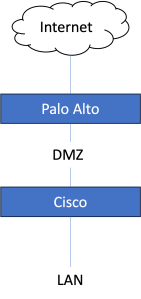
An example of this would be if your business is protected from the internet by a firewall made by Palo Alto. Behind this PA firewall is a DMZ and the DMZ is separated from your internal network by a firewall from Cisco. This layered defense will make it more difficult for attackers to get through the external firewall, DMZ, internal firewall and into the LAN. (See image below for a very simplistic visual)

Downside Of All The Things

All the things may sound great, but unless you are required to meet that level of security there can be a lot of downsides.

First, multiple technologies introduce complexity into an environment. This can make it more difficult to troubleshoot or detect issues (including security events). It can also make it more difficult to operationally support these technologies because they may have different interfaces, APIs, protocols, configurations, etc. It may not be possible to centrally manage these technologies, or it may require the introduction of an additional technology to manage everything.

Second, all of these technologies can increase the number of people required to support them. People time can really add up as a hidden cost and shouldn’t be thrown away lightly. People time starts the second you begin discussing the requirements for a new technology and can include the following:

  • Proof of Concepts (PoCs)
  • Tradeoff & Gap Analysis
  • Requests for Information (RFI)
  • Requests for Proposal (RFP)
  • Requests for Quotes (RFQ)
  • Contract Negotiation
  • Installation
  • Integration
  • Operation & Support

Finally, multiple technologies can cause performance impacts, increased costs and waste. Performance impacts can happen due to differences in technologies, complexity, configuration errors or over consumption of resources (such as agent sprawl). Waste can happen due to overlap and duplicated functionality because not all of the functionality may not get used despite the fact you are paying for it.

Advantages and Disadvantages Of A Single Tool

A single tool that covers the majority, but not all, of your requirements offers one advantage – simplicity. This may not sound like much, but after years of chasing perfection, technology simplicity can have benefits that may not be immediately obvious.

First, seeking out a single tool that meets the majority of requirements will force your security team to optimize their approach for the one that best manages risk while supporting the objectives of the business. Second, a single tool is easier to install, integrate, operate and support. There is also less demand on the rest of the business in terms of procurement, contract negotiation and vendor management. Lastly, a single tool requires less people to manage it and therefore you can run a smaller and more efficient organization.

The biggest disadvantage of a single tool is it doesn’t provide defense in depth. One other disadvantage is it won’t meet all of your security requirements and so the requirements that aren’t met should fall within the risk tolerance of the business or somehow get satisfied with other compensating controls.

A single tool that covers the majority, but not all, of your requirements offers one advantage – simplicity.

Wrapping Up

There are a lot of advantages to meeting all of your requirements with multiple tools, but these advantages come with a tradeoff in terms of complexity, operational overhead, duplicated functionality and increased personnel requirements. If you operate a security program in a highly regulated or highly secure environment you may not have a choice so it is important to be aware of these hidden costs. A single tool reduces complexity, operational overhead and personnel demands, but can leave additional risk unmet and fails to provide defense in depth. Generally, I favor simplicity where possible, but you should always balance the security controls against the risk tolerance and needs of the business.

If Data Is Our Most Valuable Asset, Why Aren’t We Treating It That Way?

There have been several high profile data breaches and ransomware attacks in the news lately and the common theme between all of them has been the disclosure (or threat of disclosure) of customer data. The after effects of a data breach or ransomware attack are far reaching and typically include loss of customer trust, refunds or credits to customer accounts, class action lawsuits, increased cyber insurance premiums, loss of cyber insurance coverage, increased regulatory oversight and fines. The total cost of these after effects far outweigh the cost of implementing proactive security controls like proper business continuity planning, disaster recovery (BCP/DR) and data governance, which begs the question – if data is our most valuable asset, why aren’t we treating it that way?

The Landscape Has Shifted

Over two decades ago, the rise of free consumer cloud services, like the ones provided by Google and Microsoft, ushered in the era of mass data collection in exchange for free services. Fast forward to today, the volume of data growth and the value of that data has skyrocketed as companies have shifted to become digital first or mine that data for advertising purposes and other business insights. The proliferation of AI has also ushered in a new data gold rush as companies strive to train their LLMs on bigger and bigger data sets. While the value of data has increased for companies, it has also become a lucrative attack vector for threat actors in the form of data breaches or ransomware attacks.

The biggest problem with business models that monetize data is: security controls and data governance haven’t kept pace with the value of the data. If your company has been around for more than a few years chances are you have a lot of data, but data governance and data security has been an afterthought. The biggest problem with bolting on security controls and data governance after the fact is it is hard to reign in pandoras box. This is also compounded by the fact that it is hard to put a quantitative value on data, and re-architecting data flows is seen as a sunk cost to the business. The rest of the business may find it difficult to understand the need to rearchitect their entire business IT operations since there isn’t an immediate and tangible business benefit.

Finally, increased global regulation is changing how data can be collected and governed. Data collection is shifting from requiring consumers to opt-out to requiring them to explicitly opt-in. This means consumers and users (an their associated data) will no longer be the presumptive product of these free services without their explicit consent. Typically, increased regulation also comes with specific requirements for data security, data governance and even data sovereignty. Companies that don’t have robust data security and data governance are already behind the curve.

False Sense Of Security

In addition to increased regulation and a shifting business landscape, the technology for protecting data really hasn’t changed in the past three decades. However, few companies implement effective security controls on their data (as we continue to see in data breach notifications and ransomware attacks). A common technology used to protect data is encryption at rest and encryption in transit (TLS), but these technologies are insufficient to protect data from anything except physical theft and network snooping (MITM). Both provide a false sense of security related to data protection.

Furthermore, common regulatory compliance audits don’t sufficiently specify protection of data throughout the data lifecycle beyond encryption at rest, encryption in transit and access controls. Passing these compliance audits can give a company a false sense of security that they are sufficiently protecting their data, when the opposite is true.

Just because you passed your compliance audit, doesn’t mean you are good to go from a data security and governance perspective.

Embrace Best Practices

Businesses can get ahead of this problem to make data breaches and ransomware attacks a non-event by implementing effective data security controls and data governance, including BCP/DR. Here are some of my recommendations for protecting your most valuable asset:

Stop Storing and Working On Plain Text Data

Sounds simple, but this will require significant changes to business processes and technology. The premise is the second data hits your control it should be encrypted and never, ever, unencrypted. This means data will be protected even if an attacker accesses the data store, but it also will mean the business will need to figure out how to modify their operations to work on encrypted data. Recent technologies such as homomorphic encryption have been introduced to solve these challenges, but even simpler activities like tokenizing the data can be an effective solution. Businesses can go one step further and create a unique cryptographic key for every “unique” customer. This would allow for simpler data governance, such as deletion of data.

Be Ruthless With Data Governance

Storage is cheap and it is easy to collect data. As a result companies are becoming digital data hoarders. However, to truly protect your business you need to ruthlessly govern your data. Data governance policies need to be established and technically implemented before any production data touches the business. These policies need to be reviewed regularly and data should be purged the second it is no longer needed. A comprehensive data inventory should be a fundamental part of your security and privacy program so you know where the data is, who owns it and where the data is in the data lifecycle.

The biggest problem with business models that monetize data is: security controls and data governance haven’t kept pace with the value of the data.

Ruthlessly governing data can have a number of benefits to the business. First, it will help control data storage costs. Second, it will minimize the impact of a data breach or ransomware attack to the explicit time period you have kept data. Lastly, it can protect the business from liability and lawsuits by demonstrating the data is properly protected, governed and/or deleted. (You can’t disclose what doesn’t exist).

Implement An Effective BCP/DR and BIA Program

Conducting a proper Business Impact Analysis (BIA) of your data should be table stakes for every business. Your BIA should include what data you have, where it is and most importantly, what would happen if this data wasn’t available? Building on top of the BIA should be a comprehensive BCP/DR plan that appropriately tiers and backs up data to support your uptime objectives. However, it seems like companies are still relying on untested BCP/DR plans or worse solely relying on single cloud regions for data availability.

Every BCP/DR plan should include a write once, read many (WORM) backup of critical data that is encrypted at the object or data layer. Create WORM backups to support your RTO and RPO and manage the backups according to your data governance plan. Having a WORM backup will prevent ransomware attacks from being able to encrypt the data and if there is a data breach it will be meaningless because the data is encrypted. BCP / DR plans should be regularly tested (up to full business failover) and security teams need to be involved in the creation of BCP/DR plans to make sure the data will have the confidentiality, integrity and availability when needed.

Don’t Rely On Regulatory Compliance Activities As Your Sole Benchmark

My last recommendation for any business is – just because you passed your compliance audit, doesn’t mean you are good to go from a data security and governance perspective. Compliance audits exist as standards for specific industries to establish a minimum bar for security. Compliance standards can be watered down due to industry feedback, lobbying or legal challenges and a well designed security program should be more comprehensive than any compliance audit. Furthermore, compliance audits are typically tailored to specific products and services, have specific scopes and limited time frames. If you design your security program to properly manage the risks to the business, including data security and data governance, you should have no issues passing a compliance audit that assesses these aspects.

Wrapping Up

Every business needs to have proper data security and data governance as part of a comprehensive security program. Data should never be stored in plain text and it should be ruthlessly governed so it is deleted the second it is no longer needed. BCP/DR plans should be regularly tested to simulate data loss, ransomware attacks or other impacts to data and, while compliance audits are necessary, they should not be the sole benchmark for how you measure the effectiveness of your security program. Proper data protection and governance will make ransomware and data breaches a thing of the past, but this will only happen if businesses stop treating data as a commodity and start treating it as their most valuable asset.

What’s The Relationship Between Security Governance and Organizational Maturity?

Organizational and security governance is touted as a key component of any successful security program. However, I’ve been thinking about governance lately and how it relates to the overall maturity of an organization. This has prompted some questions such as: what happens if you have too much governance? and What’s the relationship between security governance and organizational maturity?

What Is Governance?

First, let’s talk about what governance is.

Governance is the process by which an organization defines, implements and controls the business.

Let’s unpack what this means for a security organization. The process of defining security for the business is done through policies, standards and guidelines. Security policies are requirements the business must meet based on laws, regulations or best practices adopted by the business. These policies align to business objectives. Implementation is done through security controls that are put in place to meet a specific policy or to manage a risk. Lastly, controlling the business is done via audits and compliance checks. The security org follows up on how well the business is following policies, implementing controls and managing risk. Control can also include enforcement, which can involve gating processes, such as requiring approval for business critical and high risk activities, or recommending additional security requirements for the business to manage a risk.

Why Do We Need Governance At All?

In an ideal world we wouldn’t. Imagine a business that is created entirely of clones of yourself. There would be implicit and explicit trust between you and your other selves to do what is best for the business. Communication would be simple and you would already be aligned. In this case you don’t need a lot (or any) governance because you can trust yourself to do the things. However, unless you are Michael Keaton in Multiplicity, this just isn’t a reality.

Governance achieves a few things for a business. First, it communicates what is required of its employees and aligns those employees to common objectives. Second, it helps employees prioritize activities. None of this would be needed if human’s weren’t so complex with diverse backgrounds, experiences, perspectives, education, etc. In an ideal world we wouldn’t need any governance at all. The reality is, we do need governance, but it needs to be balanced so it doesn’t unnecessarily impede the business.

How Does This Relate To Organizational Maturity?

Organizational maturity refers to how your employees are able to execute their tasks to achieve the objectives of the business. This relates to things like the quality of code, how quickly teams resolve operational issues or how efficiently they perform a series of tasks. It can be loosely thought of as efficiency, but I actually think it combines efficiency with professionalism and integrity. Maturity is knowing what good is and being able to execute efficiently to get there. There is a fantastic book about this topic called Accelerate: The Science of Lean Software and DevOps: Building High Performing Technology Organizations by Nicole Forsgren PhD.

Which brings us to the relationship of governance and maturity…

There is an inverse relationship between organizational maturity and organizational governance. In simple terms:

The less mature an organization, the more governance is needed.

For example, if your organization struggles to apply patches in a timely manner, continually introduces new code vulnerabilities into production or repeatedly demonstrates behavior that places the business at risk, then your organizational maturity is low. When organizational maturity is low, the business needs to put processes and controls in place to align employees and direct behavior to achieve the desired outcomes. In the examples above, increased governance is an attempt to manage risk because your employees are behaving in a way that lacks maturity and is placing the business at risk.

What causes low organizational maturity?

Organizational maturity is a reflection of employee behavior, skillset, knowledge, education and alignment. In other words, organizational maturity is a reflection of your organizational culture. In practical terms your employees may simply not know how to do something. They may not have experience with working for your type of business or in the industry you operate in. Perhaps they had a really bad boss at a past job and learned bad behavior. Whatever the reason, low organizational maturity is linked to lots of sub-optimal outcomes in business.

How To Improve Organizational Maturity?

If governance and maturity are inversely linked, the question becomes how can we increase organizational maturity so we need less governance? There are a lot of ways to increase organizational maturity. One that is fairly obvious is to start with a mature organization and maintain it over time. However, this is easier said than done and is why some organizations are fanatical about culture. This relates to everything from hiring to talent management and requires strong leadership at all levels of the company.

Other ways to improve organizational maturity are through training and education. This is why security awareness and training programs are so critical to a successful security program. Security awareness and training programs are literally attempting to improve organizational maturity through education.

One last way to improve maturity is via process. The security organization can establish a new process that all teams must follow. As teams go through this process you can educate them and reward teams that exhibit the ideal behavior by relaxing the process for them. You can also help teams educate themselves by publishing the requirements and making the process transparent. The challenge with imposing a new process is having the discipline to modify or remove the process when needed, which comes back to governance.

What’s the right level of governance?

The optimal level of governance is going to be based on your organizational maturity and desired business outcomes. In order to determine if you have too much or too little governance you need to measure organizational maturity and the effectiveness of existing organizational governance. There are industry standard processes for measuring organizational maturity, like the Capability Maturity Model Integration (CMMI) and Six Sigma, or you can create your own metrics. Some ways to measure governance effectiveness are:

  • Ask For Feedback On Security Processes – Are the processes effective? Do teams view them as an impediment or are they viewed favorably? Are the processes easy to navigate and objective or are they opaque and subjective?
  • Measure Effectiveness Of Security Controls – Are your security controls effective? If you ask a team to do work to implement a security control you should have clear metrics that determine if that control is effective. If you implement a control, but that control hasn’t changed the outcome, then the control is ineffective. This can indicate your governance is ineffective or your organizational maturity needs to improve.
  • Assess and Update Policy – Security policies should be living documents. They shouldn’t be set in stone. Security policies need to map back to laws and regulations they support and the business requirements needed to be successful. Laws, regulations and business requirements all change over time and so should your security policies. By having up to date and relevant security policies you can ensure your organizational governance matches the maturity of the business.

What Are Typical Scenarios For Governance And Maturity?

There are four scenarios related to governance and maturity:

A mature organization with too much governance – your organization is mature, but you are overly controlling with process and requirements. The net effect will be to slow down and impede the business unnecessarily. You are effectively lowering the organizational maturity due to too much governance.

An immature organization with too little governance – this is a recipe for disaster. If your organization is immature and you fail to govern the organization you will open the business up to unnecessary risk. You will get out maneuvered by your competitors, you will miss opportunities, you will fail to comply with laws and regulations and generally will have a lot of activity without any result. Your employees will lack coordination and as a result your business will suffer.

A mature organization with too little governance – This isn’t a bad scenario to be in. A mature organization implies they are doing the right things and don’t need a lot of guidance. A laissez faire attitude may be the right thing to allow employees flexibility and freedom, but it does come with inherent risk of not being compliant with laws and regulations. It may also mean there is duplication of effort or multiple ways of doing things, which could be optimized.

Governance and maturity are balanced – obviously this is the ideal scenario where your organizational governance is balanced to the level of maturity of the organization. Easy to think about in practice, difficult to achieve in reality.

Wrapping Up

Organizational governance and maturity are inversely related and need to be balanced in order for the business to operate effectively. There are ways to measure organizational maturity and governance effectiveness and by having a continual feedback loop you can optimally align both for success.