How CIOs, CTOs and the rest of the C-Suite Can Better Support CISOs

There are a variety of reporting structures for CISOs, such as reporting to the CTO, CIO, CFO or CEO. No matter who the CISO reports to, the CISO is still an integral part of the C-Suite. Yet despite this, CISOs don’t always receive full support from the rest of their C-Suite peers, which can cause friction and open up the business to risk. In this post I’ll cover how the rest of the C-Suite can better support their CISO peers and how doing so will actually help them achieve their goals as well.

Strategic Planning

First and foremost, the CISO needs to be included in strategic planning sessions about new markets, mergers and acquisitions (M&A), divestitures, new product launches and new customer types. Each of these areas will create new security risks and regulatory requirements that can have lengthy lead times for addressing. The CISO needs to be informed about product roadmaps, new features and new technology initiatives. If the CISO and security group are left out of these strategic discussions the business could be forced to delay a new business opportunity or worse enter the new opportunity without properly managing the risks.

Master The Fundamentals

Second, CTOs and CIOs need their teams to master and execute on the fundamentals. This means things like asset inventory, logging, observability, QA, QC and operations support (event notification and cost analysis). The reality is the rest of the business needs these things and these are not problems the CISO should own, yet if they are not in place they will cripple a security program. For this reason, a lot of CISOs will try to tackle these issues, but they won’t be successful without support from the C-Suite that actually owns these functions. So, one of the best ways the CTO and CIO can support the CISO is to lead the way on the heavy lifting for these fundamentals that way the CISO can draft off of these and focus on making their security program as effective as possible to manage risk.

Accountability

Speaking of mastering the fundamentals, what we are really talking about is accountability. The rest of the C-Suite needs to hold their teams accountable for completing or resolving security issues. This could be things like resolving technical debt, completing training, fixing vulnerabilities or appropriately prioritizing security requests. If accountability isn’t enforced at the C-Suite, then the rest of the business will become siloed and ignore other initiatives across the company. This can cause security issues to pile up and open up the business to risk that will be impossible for the CISO to manage. By holding your teams accountable and partnering with the CISO function you will create a partnership that can accelerate the business instead of creating unnecessary friction.

One easy way to get visibility into what your teams are doing, so you can drive accountability, is with an exceptions process. Exceptions are a common process for a security function and it allows the security team to have escalating levels of approval based on risk. It also allows for reporting and metrics about how many exceptions a team has requested, how many have been approved and how long it takes the team to resolve an exception. This can provide other C-Suite members valuable insights into how their function is performing with respect to their security commitments and it also allows the C-Suite to drive accountability into their functions by acting as the senior executive approver for critical risks in their function.

An exceptions process doesn’t have to be just for security. The entire company can benefit from an exceptions process such as for purchasing, contracts, sales, finance and engineering. Exceptions across the company can give visibility, promote good friction and drive accountability.

Support Good Friction

There are two different types of friction in a company and we have all experienced them. Good friction exists to help slow people down to consider their actions or minimize risk. These are processes like confirming large financial transactions or requiring validation of someone’s identity before using a critical resource. Bad friction wastes people’s time and is adversarial. These are processes that are inefficient, people that exercise unnecessary control over others or people that never follow through on activities. This type of friction needs to be avoided.

The rest of the C-Suite can support the creation of good friction with respect to security and how security engages with their teams. Good friction can actually accelerate the business by front loading activities where they will take less time, instead of trying to resolve issues later in the lifecycle where they are incredibly difficult and expensive to resolve. Some examples of good friction are security checks as part of the CI/CD pipeline, like SAST, automated attack simulation, or automated compliance reviews. When the rest of the C-Suite supports good friction it will actually make everyone’s job easier and less risky.

Help Advocate For Security

Another way the rest of the C-Suite can support the CISO is by helping to advocate the value of the security function beyond being an insurance policy or compliance function. While the security function may be viewed as a cost center, it can actually drive revenue and generate value. By including the CISO in the strategic planning process, CISOs can advocate product features with customers and engage with customers in a more proactive way. CISOs can also work with the go to market and finance teams to create processes for tracking customer engagements by the security team. This can shed light into the direct and indirect ways the security function is driving revenue, which can change the perspective of the security function from simply being a cost center. Having other C-Suite members advocate and support the CISO with customer engagements, building revenue tracking and involving the security team in all phases of the business can help improve the value of security and reduce overall risk.

Cultural Change

The last area the C-Suite can help the CISO with is cultural change. The Chief People Officer or Chief HR officer can work with the CISO to create and adapt comp structures for the security team that reflects the competitiveness of the market. They can also work with the CISO to create career paths, training and job specific performance metrics for the security function. The Chief People Officer and the HR function are also critical partners for the CISO to backstop security policies and enforce these policies across the company. HR can create and enforce consequences for policy violations, such as lack of eligibility for promotion, and they can also help manage the worst offenders with termination. HR can also set incentives to reward good security behavior such as giving spot bonuses, rapid promotions or even tying bonuses to completion of key security goals.

Outside of the culture of the security function, the rest of the C-Suite can set the tone for the culture with respect to how the company should view and engage with security. In particular, the C-Suite can lay the foundation for a security first culture and hold people accountable for implementing this throughout their functions. They can also shift the culture by holding business owners accountable for the things they own. Lastly, if the rest of the C-Suite carries KPIs, OKRs or other annual performance metrics as part of their annual goals this can help cross pollinate and incentivize the entire company to execute on effectively managing risk.

Wrapping Up

Close partnership with the rest of the C-Suite is essential for the CISO to be successful. The rest of the C-Suite can support the CISO and the security function by involving the CISO in strategic planning, driving accountability, mastering the fundamentals, supporting good friction, advocating for security and helping to drive cultural change. By supporting these areas, the rest of the C-Suite will set the tone from the top and work with the CISO to govern the risk of the business in a way that allows it to eliminate bad friction, accelerate growth and remain competitive.


A CISO’s Analysis Of the CrowdStrike Global Outage

Overnight from July 18 to July 19, 2024, Windows systems running CrowdStrike ceased functioning and displayed the blue screen of death (BSOD). As people woke up on the morning of July 19th they discovered a wide reaching global outage of the consumer services they rely on for their daily lives, such as healthcare, travel, fast food and even emergency services. The ramifications of this event will continue to be felt for at least the next week as businesses recover from the outage and investors react to the realization that global businesses are extremely fragile when it comes to technology and business operations.

Technical Details

An update by CrowdStrike (CS) to the C-00000291*.sys file dated 0409UTC was pushed to all customers running CS Falcon agents. This file was corrupt (reports indicate a null byte header issue) and when Windows attempted to load this file it crashed. Rebooting the impacted systems does not resolve the issue because of the way CS Falcon works. CS Falcon has access to the inner workings of the operating system (kernel) such as memory access, drivers, and registry entries that allow CS to detect malicious software and activity. The CS Falcon agent is designed to receive updates automatically in order to keep the agent up to date with the latest detections. In this case, the update file was not properly tested and somehow made it through Quality Assurance and Quality Control, before being pushed globally to all CS customers. Additionally, CrowdStrike customers are clearly running CS Falcon on production systems and do not have processes in place to stage updates to CS Falcon in order to minimize the impact of failed updates (more on this below).

Global Impact

This truly is a global outage and the list of industries is far reaching attesting to the success of CS, but also the risks that can impact your software supply chain. As of Monday, Delta airlines is still experiencing flight cancellations and delays as a result of impacts to their pilot scheduling system. The list of impacted companies can be found here, here and here, but I’ll provide a short list as follows:

Travel – United, Delta, American, major airports

Banking and Trading – VISA, stock exchanges

Emergency & Security Services – Some 911 services and ADT

Cloud Providers – AWS, Azure

Consumer – Starbucks, McDonalds, FedEx

Once the immediate global impact subsides, there will be plenty of finger pointing at CrowdStrike for failing to properly test an update, but what this event clearly shows is a lack of investment by some major global companies in site reliability engineering (SRE), business continuity planning (BCP), disaster recovery (DR), business impact analysis (BIA) and proper change control. If companies were truly investing in SRE, BCP, DR and BIA beyond a simple checkbox exercise, this failed update would have been a non-event. Businesses would have simply executed their BCP / DR plan and failed over, or immediately recovered their critical services to get back up and running (which some did). Or, if they are running proper change control along immutable infrastructure they could have immediately rolled back to the last good version with minimal impact. Clearly, more work needs to be done by all of these companies to improve their plans, processes and execution when a disruptive event occurs.

Are global companies really allowing live updates to mission critical software in production without going through proper testing? Or even better, production systems should be immutable, preventing any change to production without being updated in the CI/CD pipeline and then re-deployed. Failed updates became an issue almost two decades ago when Microsoft began patch Tuesday. Companies quickly figured out they couldn’t trust the quality of the patches and instead would test the patches in staging, which runs a duplicate environment to production. While this may have created a short window of vulnerability, it came with the advantages of stability and uninterrupted business operations.

Modern day IT Operations (called Platform Engineering or Site Reliability Engineering) now design production environments to be immutable and somewhat self healing. All changes need to be updated in code and then re-pushed through dev , test and staging environments to make sure proper QA and QC is followed. This minimizes impact from failed code pushes and will also minimize disruption from failed patches and updates like this one. SRE also closely monitors production environments for latency thresholds, availability targets and other operational metrics. If the environment exceeds a specific threshold then it throws alerts and will attempt to self heal by allocating more resources, or by rolling back to the previous known good image.

Ramifications

Materiality

Setting aside maturity of business and IT operations, there are some clear ramifications for this event. First, this had a global impact to a wide variety of businesses and services. Some of the biggest impacts were felt by publicly traded companies and as a result these companies will need to make an 8K filing with the SEC to report a material event to their business. Even though this wasn’t a cybersecurity attack, it was still an event that disrupted business operations and so companies will need to report the expected impact and loss accordingly. CrowdStrike in particular will need to make an 8K filling, not only for loss of stock value, but for expected loss of revenue through lost customers, contractual concessions and other tangible impacts to their business. When I started this post Friday of the even, CS stock was down over 10% and by Monday morning they were down almost 20%. The stock has started to recover, but that is clearly a material event to investors.

Greater Investment In BCP / DR & BIA

Recent events, such as this one and the UHC Change Healthcare ransomware attack, have clearly shown that some business are not investing properly in BCP / DR. They may have plans on paper, but plans still need to be fully tested including rapidly identifying service degradation and implementing recovery operations as quickly as possible. The reality is this should have been a non-event and any business that was impacted longer than a few hours needs to consider additional investment in their BCP / DR plan to minimize the impact of future events. CISOs need to work with the rest of the C-Suite to review existing BCP / DR plans and update them accordingly based on the risk tolerance of the business and desired RTO and RPO.

Boards Need To Step Up

During an event like this one boards need to take a step back and remember their primary purpose is to represent and protect investors. In this case, the sub-committees that govern technology, cybersecurity and risk should be asking hard questions about how to minimize the impact of future events like this and consider if the existing investment in BCP / DR technology and processes is sufficient to offset a projected loss of business. This may include more frequent reports on when the last time BCP / DR plans were properly tested and if those plans are properly accounting for all of the possible scenarios that could impact the business such as ransomware, supply chain disruption or global events like this one. The board may also push the executive staff to accelerate plans to invest in and modernize IT operations to eliminate tech debt and adopt industry best practices such as immutable infra or SRE. The board may also insist on a detailed analysis of the risks of the supply chain, including plans to minimize single points of failure, while limiting the blast radius of future events.

Negative Outcomes

Unfortunately, this event is likely to cause a negative perception of cybersecurity in the short term for a few different reasons. First, the obvious business disruption is one people will be questioning. How, is it a global cybersecurity company is able to disrupt so much with a single update? Could this same process act as an attack vector for attackers? Reports are already indicating that malicious domains have been set up to look like the fix for this event, but instead push malware. There are also malicious domains that have been created for phishing purposes and the reality is any company impacted by this event may also be vulnerable to ransomware attacks, social engineering and other follow on attacks.

Second, this event may cause a negative perception of automatic updates within the IT operations groups. I personally believe this is the wrong reaction, but the reality is some businesses will turn off the auto-updates, which will leave them more vulnerable to malware and other attacks.

The reality is this should have been a non-event and any business that was impacted longer than a few hours needs to consider additional investment in their BCP / DR plan to minimize the impact of future events.

What CISOs Should Do

With all this in mind, what should CISOs do to help the board, the C-Suite and the rest of the business navigate this event? Here are my suggestions:

First, review your contractual terms with 3rd party providers to understand contractually defined SLAs, liability, restitution and other clauses that can help protect your business due to an event caused by a third party. This should also include a risk analysis of your entire supply chain to determine single points of failure and how to protect your business appropriately.

Second, insist on increased investment in your BIA, BCP and DR plans including designing for site reliability and random events (chaos monkey) to proactively identify and recover from disruption, including review of RTO and RPO. If your BCP / DR plan is not where it needs to be, it may require investment in a multi-year technology transformation plan including resolving legacy systems and tech debt. It may also require modernizing your SDLC to shift to CI/CD including dev, test, staging and prod environments that are tightly controlled. The ultimate goal will be to move to immutable infrastructure and IT operations best practices that allow your services to operate and recover without disruption. I’ve captured my thoughts on some of the best practices here.

Third, resist the temptation to over react. The C-Suite and investors are going to ask some hard questions about your business and they will suggest a wide range of solutions such as turning off auto-patches, ripping out CS or even building your own solution. All of these suggestions have a clear tradeoff in terms of risk and operational investment. Making a poor, reactive, decision immediately after this event can harm the business more than it can help.

Finally, for mission critical services consider shifting to a heterogeneous environment that statistically minimizes the impact of any one vendor. The concept is simple, if you need an security technology to protect your systems consider purchasing multiple vendors that all have similar capabilities, but will minimize the impact of your business operations if one of them has an issue. This obviously raises the complexity and operational cost of your environment and should only be used for mission critical or highly sensitive services that need to absolutely minimize any risk to operations. However, this event does highlight the risks of consolidating to a single vendor and you should conduct a risk analysis to determine the best course of action for your business and supply chain.

Wrapping Up

For some companies this was a non-event. Once they realized there was an outage they simply executed their recovery plans and were back online relatively quickly. For other companies, this event highlighted lack of investment in IT operations fundamentals like BCP / DR or supply chain risk management. On the positive side, this wasn’t a ransomware or other cybersecurity attack and so recovery is relatively straightforward for most businesses. On the negative side, this event can have negative consequences if businesses over react and make poor decisions. As a CISO, I highly recommend you take advantage of this event to learn from your weaknesses and make plans to shore up aspects of your operations that were sub-standard.

Tips For Managing Anxiety, Stress, Burnout and Mental Health

CISOs have been in the hot seat lately, particularly related to personal liability, increasing regulatory pressure and a shifting technological landscape. Compound these macro issues with the internal demands CISOs deal with such as incidents, budget cuts or political battles for relevancy and it is no wonder CISOs are struggling with mental health issues. All of these macro and micro issues weigh on a CISO and can cause anxiety, stress or burnout. In this post I’ll discuss methods for identifying, avoiding and managing anxiety, stress and burnout over your career as a CISO.

Maturing Your Program

One of the first areas you should evaluate is the maturity of your security program and in particular how to shift from being reactive to proactive. When you are reactive all the time you are waiting for things to happen instead of taking control of your situation and removing as much uncertainty as possible. This can be as simple as establishing playbooks, documenting your program or creating better detections. Perform an honest evaluation about the maturity of your security program and work with the rest of the business to identify areas you can standardize, automate or improve so you can become more proactive. Here are a few examples to give you some ideas:

  1. Standardize responses to customer questionnaires so you don’t have to continually answer the same questions. Publish the answers in a location where sales teams can find them and provide them to customers as needed.
  2. Standardize security and privacy contractual language. By standardizing language you reduce the need to negotiate, red line and haggle back and forth about terms, which can cause a big drain on your team.
  3. Reduce false positives by improving detections or tuning rule sets. By reducing false positives you will reduce the number of times your team gets called up to help solve an issue that never should have existed in the first place. Continually responding to non-issues can rapidly result in burnout and even dull your team’s response mechanism causing poor performance during a true incident.
  4. Hire more people to provide proper coverage so people aren’t getting woken up or working after hours.
  5. Create standard playbooks so everyone is following the same process when there is an incident.
  6. Conduct regular table tops to test your ability to respond. Continually iterate and improve so a true incident is a non-event.
  7. Meticulously document your security program so compliance and audit activities are a non-event.

These are just a few examples of ways to shift from being reactive to proactive. By documenting and evaluating your program against a standard framework you can identify opportunities for maturing your program, which will help shift your program to be more proactive. By being more proactive you will naturally reduce stress, anxiety and burnout among yourself and your team members.

There are a few other ways you can reduce stress and anxiety in your security program. First, you can delegate more to your staff allowing them growth opportunities, while allowing you much needed down time. Second, build rapport with the rest of the business by documenting decisions on risk and getting the business owners to sign off on those decisions. Reduce unnecessary friction in your security program and establish credibility with your peers. By creating allies across the rest of the business you can shift from an adversarial relationship to a trusted advisor of the business and this will naturally reduce stress and anxiety.

Lastly, as a CISO, you can reduce personal stress and anxiety by thoroughly documenting your program and getting major decisions in writing. This can help protect you from personal liability by reducing the likelihood you will become a scapegoat and will provide a record of accountability for decisions in case you end up getting sued or held accountable by some other regulatory action. You should also request coverage on the D&O liability policy and make sure you have legal coverage if needed because both will give you piece of mind.

By creating allies across the rest of the business you can shift from an adversarial relationship to a trusted advisor of the business and this will naturally reduce stress and anxiety.

Nosce Te Ipsum (Know Thyself)

Once you have a plan in place to mature your security program and reduce personal liability, the next area to work on is yourself. The normal cadence of life, including our interactions with co-workers, family members and friends can all cause stress, anxiety and burnout. It is important to acknowledge that we are humans and these are normal feelings, but by performing regular self reflection we can identify the causes of these feelings and attempt to manage or eliminate them. Here are a few things to think about:

  1. Where do you have agency (ownership and control) in your job and life? Worrying about things you can’t control or trying to control things beyond your control can increase stress and anxiety, which will lead to burnout.
  2. Identify triggers. What triggers you? Does someone at work constantly set you off? Do you get really irritable when you haven’t eaten? Does waiting for an impending scenario at work (like an incident) eat away at you? Identify the things that cause you stress and anxiety and work to reduce them. This can be a simple conversation with someone to help them understand how their behavior is impacting you, or changing your role to eliminate situations that place you in stressful or anxiety causing situations. Most importantly, by identifying your triggers, you can attempt to control your feelings of stress and anxiety instead of simply reacting and ultimately burning out.

There are a few other things you can do to help reduce anxiety and stress throughout your day. First, set boundaries and disconnect. Do you work through lunch? Do you answer emails at all hours of the night? Block off personal time to allow time to process and reflect. Delegate after hours decisions to your staff so you aren’t answering emails at all hours of the night. Take a vacation and leave your work devices at home. Once you start setting boundaries you will normalize and set the example for your team so they can manage their anxiety and stress as well.

Another way to reduce personal anxiety and stress is to cognitively offload. Do you carry around a lot of decisions and thoughts in your head? Are you constantly trying to remember lists or activities you need to do? Start keeping a running notepad and to do list on your phone. Write down things you need to do or ideas you have so you don’t lose them. Stop carrying all these activities around in your head so you aren’t constantly trying to remember everything. Offload these things to your phone, give your self a break and reduce mental stress.

One of the last things you can do for your personal mental health is change your perspective. Western society is extremely negative and this can be compounded by social media, the news or daily interactions with others. It can seem natural to complain about situations or to view things in a negative light, but this way of thinking has a lensing effect that will impact our entire lives. Instead, be present, be grateful, stop judging things and stop complaining. Look at the positive side of situations and work hard to shift your perspective. This positive mental attitude can have a tremendous effect on reducing stress and anxiety in our lives.

Manage Your Health

Personal health is another area that can contribute to or cause stress and anxiety. Personal health is directly related to your work situation (creating a mature program) and knowing yourself in the ways I listed above. However, there are a lot of things you can do with your personal health that can help manage stress and reduce anxiety. Here is a list of things you can do:

  1. Get sunlight and exercise (take walking meetings, work outside, block off time to exercise). These are all natural stress reducers.
  2. Fix your sleep
  3. Understand your family history with stress and anxiety
  4. Reduce screen time
  5. Get off social media and stop reading the news
  6. Practice breathing exercises
  7. Explore a creative, non-work related hobby (such as art, music, etc.)
  8. See your doctor and discuss your health (including mental health), get your hormones tested
  9. Improve your eating habits (reduce processed foods)
  10. Reflect on the positive things that happened in your day and mentally prepare for the positive things you want to accomplish tomorrow
  11. Practice gratitude

Wrapping Up

There can be stigma around discussing mental health issues, particularly stress and anxiety. However, by not discussing it openly we are normalizing behaviors and feelings that impact our performance and personal health. There are a lot of ways you can reduce the amount of anxiety and stress you have on a daily basis, such as becoming more proactive, delegating, identifying triggers, cognitively offloading and improving your overall personal health. By taking an active role in our exposure to stress and anxiety we reduce the likelihood of burnout and more effectively manage our daily existence. Small changes to our daily lives, routines and interactions can have an exponential impact towards improving our mental health, which will ultimately make us better CISOs.

How Should CISOs Think About Risk?

There are a lot of different ways for CISOs to think about and measure risk, which can be bucketed into two different categories. Qualitative measurement, which is a subjective measurement that follows an objective process or quantitative measurement, which is an objective measurement grounded in dollar amounts. Quantitative risk measurement is what CISOs should strive to achieve for a few reasons. One, it grounds the risk measurement in objective numbers which removes people’s opinions from the calculation; two, it assesses risk in terms of dollar amounts, which is useful for communicating to the rest of the business; and three, it can highlight areas of immaturity across the business if they are unable to quantify how their division contributes to the overall bottom line of the company. In this post I want to explore how CISOs should think about quantitatively measuring risk and in particular, measuring mitigated, unmitigated and residual risk for the business.

Where should you start?

A good place to start is with an industry standard risk management framework like NIST 800-37, CIS RAM or ISO 31000 and for the purposes of this post I’ll stick with the NIST 800-37 to be consistent. In order for CISOs to obtain a qualitative risk assessment from the NIST 800-37 they need to add a step into the categorize step by working with finance and the business owners to understand the P&L of the system(s) they are categorizing. The first step is to go through every business system and get a dollar amount (in terms of revenue) for how much the systems(s) contribute to the overall bottom line of the business.

Internal and External Security Costs

After you get a revenue dollar amount for every set of systems, you now need to move to the assess stage of the NIST 800-37 RMF to determine which security controls are in place to protect the systems, how much they cost and ultimately what percentage the security controls cover. There are two categories of security controls and costs you will need to build a model for. The first category is internal costs, which includes:

  • Tooling and technology
  • Licenses
  • Training
  • Headcount (fully burdened cost)
  • Travel
  • R&D
  • Technology operating costs (like cloud costs directly attributable to security tooling, etc.)

The second category is external costs, which includes:

  • 3rd party penetration tests
  • Audits
  • Managed Security Service Provider (MSSP) costs
  • Insurance

As you fill in the costs or annual budget for each of these items you can map the coverage of these internal and external costs to your business to determine the total cost of your security program and how much risk the program is able to cover (in terms of a percentage).

Mapping Risk Coverage

Once you have all of these figures you can start to map risk coverage to determine if your security program is effectively protecting the business. Let’s say your business generates $1B in annual revenue. Your goal as a CISO is to maintain a security program that provides $1B of risk coverage of the business. Or, if you are unable to provide total coverage, then you need to communicate which parts of the business are not protected so the rest of the C-Suite and board can either accept the risk or approve additional funding.

As a simple example, let’s say you spend $1M/year on a SIEM tool, which takes 6 people to operate and maintain. The total cost of the 6 people is approximately $6M / yr (including benefits, etc.). The SIEM and people provide 100% monitoring coverage for the business and the SIEM and people can be mapped to 20% of your security controls in NIST. I’m skipping a lot of details for simplicity, but for a $1B business this means your SIEM function costs $7M / yr, but protects $200M of revenue ($1B x 20%). As you map the other tools, processes, people, etc. back to the business you will get a complete picture of how much risk your security program is managing and make informed decisions about your program to the board.

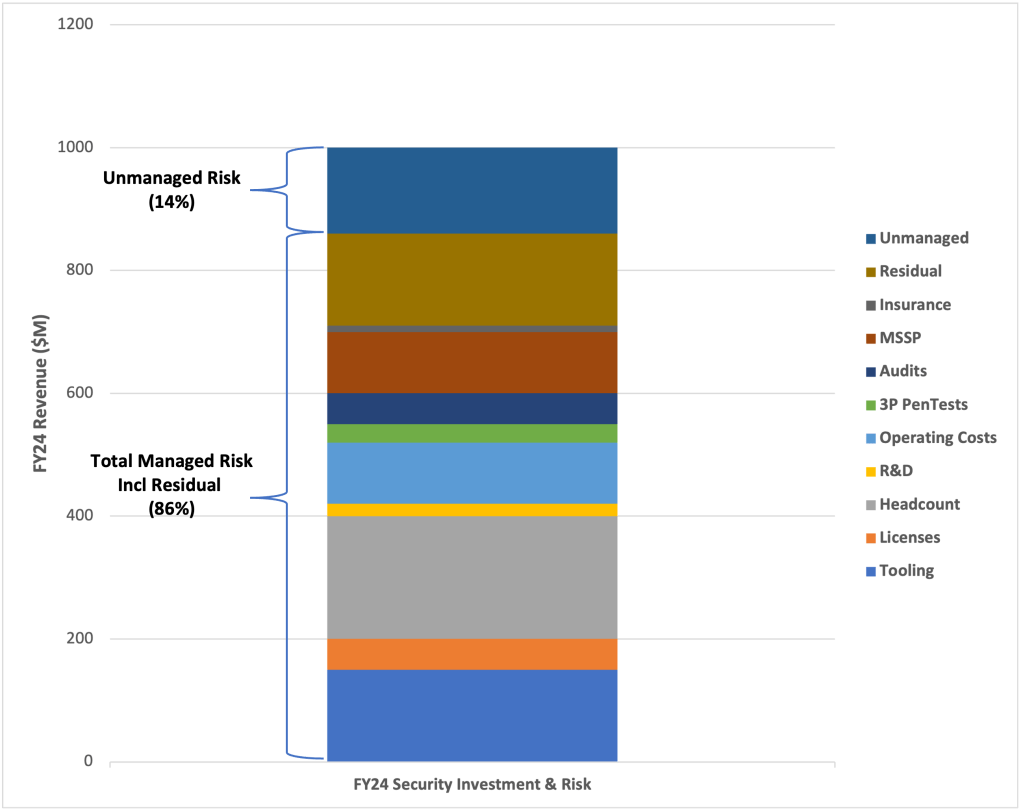
For example, you may find your security program costs $100M / year, but is only able to manage risk for $750M (75%) of the business. Your analysis should clearly articulate whether this remaining 20% of risk is residual (will never go away and is acceptable) or is unmanaged and needs attention.

Complete The Picture

By mapping your security program costs to the percentage of controls they cover and then mapping those controls to the business, CISOs should be able to get an accurate picture of the effectiveness of their security program. By breaking out the security program costs into the internal and external categories I’ve listed above, they can also compare and contrast the costs to the total amount of risk to determine which investments yield the best value. These analyses can be extremely effective when having conversations with the rest of the C-Suite or board, who may be inclined to decline additional budget requests or subjectively recommend a solution. By informing these stakeholders of the cost per control and the risk value of that cost, you can help them support your recommendation for additional investment to help increase risk management coverage or to help increase the value of risk management provided by the security program.

The following chart is an example of what this analysis can yield.

Once you have this data and analysis you can start driving conversations with the rest of the C-Suite and the board to inform them of how much risk is being managed, how much is residual, how much risk is unmanaged and your recommendation for additional investment (or acceptance). These conversations can also benefit from further analysis such as the ratio of cost to managed risk to determine which investment is providing the best value and ultimately support your recommendation for how the company should manage this risk going forward (people or technology).

Wrapping Up

Managing P&L is a fundamental skill for all CISOs to master and can help drive conversations across the company for how risk is being managed. CISOs need to master skills in financial analysis and partner with other parts of the business like business operations or business owners to understand how the business operates and what percentage of the business is effectively covered by the existing security program. The results of this analysis will help CISOs shape the conversation around risk, investment and ultimately the strategic direction of the business.

Should CISOs Be Technical?

Don’t want to read this? Watch a video short of the topic here.

There are a lot of different paths to becoming a CISO and everyone’s journey is different, however two of the most common paths are coming up through the technical ranks or transitioning over from the compliance function. Coming up through the technical ranks is common because cybersecurity is a technically heavy field, particularly when attempting to understand the complexities of how exploits work and the best way to defend against attackers. Coming up through the compliance ranks is also common because companies are often focused on getting a particular compliance certification in order for them to conduct business and interact with the customers. Each of these paths offers advantages and disadvantages, but I will argue being technical is more challenging than some of the softer cybersecurity disciplines like compliance, which leads to a common question – do CISOs need to be technical?

Yes, but…

If you don’t want to read any further the short answer is yes, CISOs need to be technical. The longer answer is, being technical is a necessary, but insufficient characteristic of a well rounded CISO. The reason being technical is insufficient is because for the past few years the CISO role at public companies has been transforming from a technical role to a business savvy executive role. CISOs are expected to report to the board, which requires speaking the language of business, risk and finance. I have seen CISOs quickly lose their audience in board meetings when they start talking about tooling, vulnerabilities and detailed technical aspects of their security program. CISOs need to be able to translate their security program into the language of risk and they need to be savvy enough to weave in financial and business terminology that the board and other C-Suite executives will understand.

Obtain (and maintain) A Technical Grounding

Even though being technical is no longer sufficient for a well rounded CISO it is important for a CISO to obtain or maintain a technical grounding. A technical grounding will help the CISO translate technical concepts (like vulnerabilities and exploits) into higher level business language like strategy, risk or profit and loss (P&L). It is also important for a CISO to understand technical concepts so they can dig in when needed to make sure their program is on track or controls are operating effectively. Lastly, it is important to maintain technical credibility with other technical C-Suite stakeholders like the CTO and CIO. Speaking their language will help align these powerful C-Suite members with your security program, who can then lend critical support when making asks for the rest of the C-Suite or board.

What other skills does a CISO need?

In addition to a technical grounding, there are a number of skills CISOs need to master in order to be effective in their role. The following is a short list of skills CISOs need to have in order to be successful at a public company:

  • Executive presence and public speaking skills with the ability to translate security concepts into business risk that resonates with senior executives and the board
  • Ability to lead and communicate during a crisis
  • Politically savvy, with ability to partner with and build alliances with other parts of the business
  • Ability to understand the core parts of the business, how they operate and what their strategy is
  • Ability to explain the “value” of your security program in business and financial terms
  • Strong understanding of financial concepts such as CAPEX, OPEX, P&L, budgeting and ability to understand balance sheets, earning results and SEC filings
  • Understand and navigate legal concepts (such as privilege), regulations and compliance activities with the ability to map these concepts back to your security program or testify in court (if needed)
  • Ability to interact with auditors (when needed) to satisfy compliance asks or guide responses
  • Ability to interact with customers to either reassure them about the maturity of your security program or act as an extension of the sales team to help acquire new customers
  • Interact with law enforcement and other government agencies, depending on the nature of the business

If this seems like a long list that doesn’t fit your concept of what a CISO does, then you may have some weaknesses you need to work on. This list also reflects the evolving nature of the CISO role, particularly with respect to board interaction and leadership at public companies. More importantly, a lot of these concepts are not covered in popular security certifications and you definitely won’t get all of this experience from start ups or non-public companies. That is ok, because recognizing and acknowledging your weaknesses is the first step to becoming a better CISO.